

Jered Ede, an Orlando-based attorney, told American Family Radio on Monday the First Amendment is not going to protect journalist Don Lemon as much as he would like.
“The First Amendment, as absolute as it is, is not a get-out-of-jail-free card. Journalists, like every American, have to follow the law or face the consequences,” Ede told show host Jenna Ellis.
 Lemon is charged under the Freedom of Access to Clinic Entrances, or FACE Act. That controversial law, signed by Bill Clinton, has been used to prosecute pro-life protesters in and around abortion clinics.
The law also protects houses of worship from political disruption, too, which is what put Lemon and several other protesters in handcuffs at the direction of Attorney General Pam Bondi.
Lemon faces two FACE Act charges. The first charge is for disrupting the Sunday morning worship service at Cities Church. The second charge, known as conspiring to violate rights, comes after Lemon filmed himself meeting with the anti-ICE protesters before they charged into the St. Paul church.
Lemon, best known for his former career at CNN, livestreamed the church protest, beginning with filming what he called "resistance protesters" who were meeting in snow-covered parking lot.
"These are resistance protesters. They're planning an operation that we're going to follow them on," Lemon tells the camera. "I can't tell you exactly what they're doing but it's called 'Operation Pull-up.'"
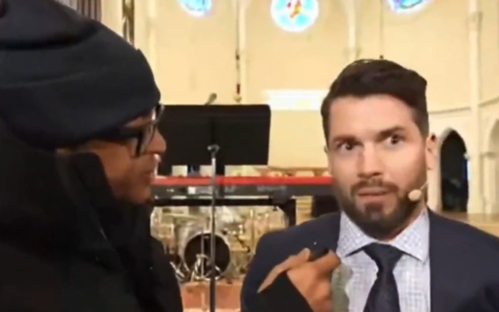
 Lemon then names the organizer of Operation Pull-up, Nekima Armstrong, who gets a surprise kiss on the cheek from Lemon (pictured at right) minutes later.
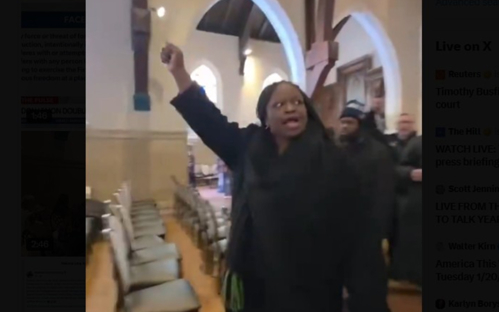
Inside the church, Lemon filmed the shouting, fist-raising protesters. He also filmed himself arguing with church members, including lead pastor Jonathan Parnell, in interviews that were confrontational and hostile.
When the church pastor calls the protest "unacceptable" and "shameful," and asks Lemon and the others to leave, Lemon tells him they have the constitutional right to free speech, and the right to assemble and protest.
"We're here to worship. We're here to worship Jesus," Parnell tells him.
"Don't you think Jesus would be understanding and love these folks?" Lemon responds.
Lemon, who can be seen putting his hands on Parnell, also accuses the pastor moments later of pushing him.
Calling himself a victim of racist critics, Lemon has since insisted he was there as a journalist covering the protest — not coordinating or participating in it.
Citing the FACE Act, the federal government disagrees and Lemon was arrested and taken into custody in Los Angeles last week.
Over at liberal CNN, where Lemon worked before he was fired in 2023, New York Post reporter Lydia Moynihan said the federal indictment alleges Lemon physically blocked churchgoers from leaving.
"No, no, it does not say that," show host Abby Phillip, seeming to correct her guest, told Moynihan.
"It actually does say that," Moynihan, who then reads from the indictment, told Phillip.
Pro-lifers hit with conspiracy charge
The First Amendment, Ede told Ellis and the AFR audience, bars the government from making laws that “abridge the freedom of speech, or of the press.”
This is interpreted to mean the government generally cannot censor, punish, or restrict journalists simply for reporting or publishing information. The press includes traditional news outlets and often other individuals or groups disseminating information.
During the Biden administration, the FACE Act was used by the Department of Justice to prosecute pro-lifers after the enraged pro-abortion side lost its constitutional right to abortion in the landmark Dobbs ruling.
Back in 2022, AFN reported how the Biden administration announced FACE Act charges against pro-lifers who protested outside an abortion clinic (pictured below) in Mount Juliet, Tenn.
 A press release from the DOJ, which can be read here, said 11 people in all were charged with blocking the entrance to the Mount Juliet Reproductive Health Center and livestreaming the protest on Facebook.
Of those 11, seven of them faced 11 years in prison after federal prosecutors said Facebook posts describing the planned protest amounted to a conspiracy charge.
Perhaps the most famous FACE Act case during Biden’s one term was Mark Houck. The pro-life activist was arrested by squad of federal agents almost a year after an incident in which he shoved an abortion supporter who was verbally abusing Houck’s son outside a Planned Parenthood abortion clinic.
Houck was shackled at the waist and feet, and was chained to a table for six hours on the day of his arrest. He faced up to 11 years in prison.
Using the same statute, the Trump administration contends that Lemon “interfered with the free exercise of religion” at a house of worship.

The indictment says Lemon began livestreaming the group as they planned and executed the protest, including footage before they entered the church and while the disruption was occurring. The Trump administration claims this wasn’t just reporting, saying Lemon sought to avoid “giving away” certain details of the planned protest.
Some watch events unfold and see similarities between the two administrations in the weaponization of the Department of Justice, Ede said.
“We saw under the Biden administration enforcements of the FACE Act that many on the right thought were inappropriate, the circumstance, for example, of Mark Houck. We have a little bit of a situation where perhaps the public is looking at the Mark Houck situation and the Don Lemon situation and saying, ‘Tell me how these are different,’” Ede said.
After a five-day trial in federal court, a 12-person jury in the Eastern District of Pennsylvania deliberated for about an hour, according to reports, before unanimously finding in favor of Houck.
“We'll see what happens with Don Lemon, but I do think generally the American public looks to and expects that the application of the law, is done equally regardless of whether there is an R or a D after the end of your name,” Ede said.
Hanlon might help Lemon fight charges
Lemon’s actions really do “make you question, is that an act of journalism or is that an act of activism? Is he merely observing, or at that point, does he participate,” Ede said.
He used the early 1990s Supreme Court case of Hanlon v. Berger as an illustration.
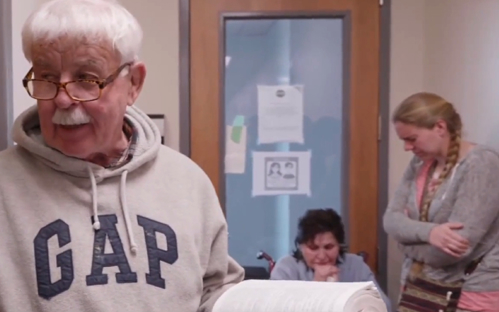
In the case the Berger family sued federal wildlife agents and media organizations including CNN. The Bergers alleged the agents violated their Fourth Amendment rights by allowing CNN and other media to accompany them when executing a search warrant on their Montana ranch.
 The First Amendment may not be a magic wand, but the Berger case, if considered, may work in Lemon’s favor.
The Fourth Amendment protects against unreasonable searches and seizures.
The Court did not rule on liability for CNN or other media outlets but did vacate and remand parts of the 9th Circuit’s appellate judgment. It cited a lack of clearly established law.
“That dealt with this issue pretty closely. Now, it wasn't a FACE Act violation, but it was the argument that journalists can accompany others onto private property and effectively have the same immunity that the others would have,” Ede said.