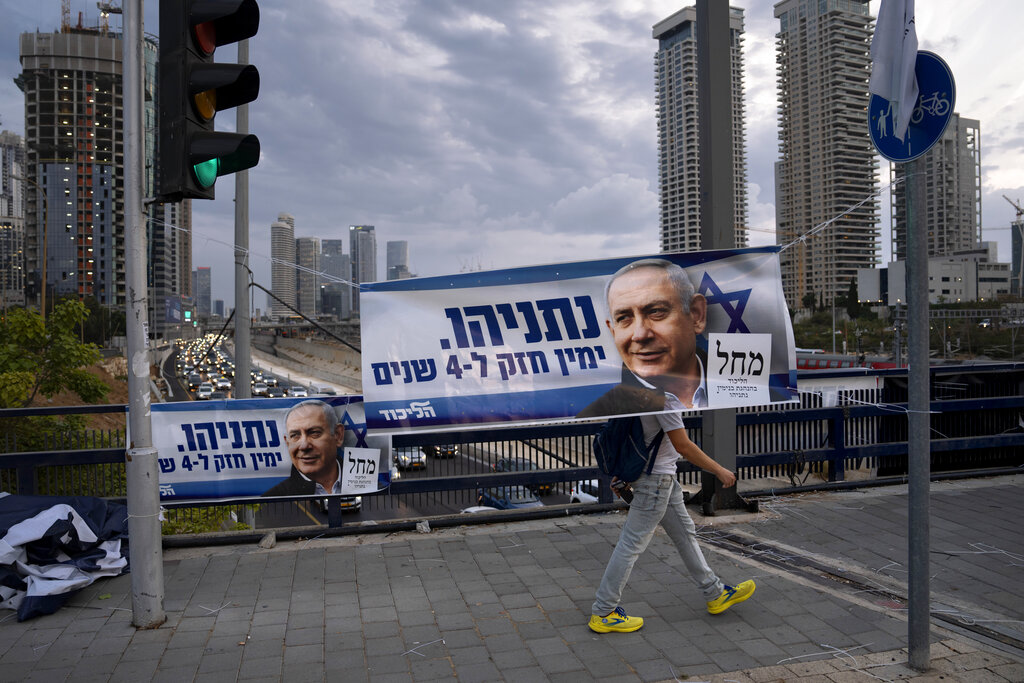



The election results leave Netanyahu down, but not out, and will require compromise in a split parliament if he is to remain in power.
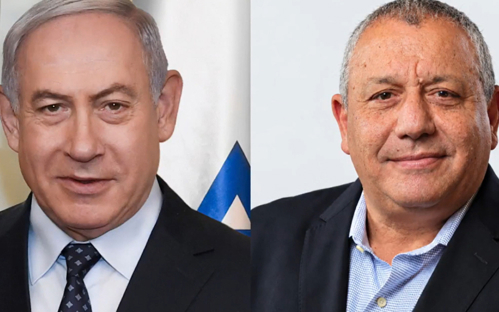
Netanyahu’s coalition of parties — Likud being the most prominent — gained 53 seats, more than his chief opponent, former army general Gadi Eisenkot, whose parties gained 48 seats. Sixty-one seats are the minimum required to declare victory and form a government.
President Isaac Herzog will begin talks with the parties and will name the candidate he believes has the best chance to form a government. If that candidate fails, a second candidate will try. If the process washes out after 100 days, another election would be held.
While Netanyahu alleges foreign interference, primarily from Qatar and Turkey, he’s going to have to recruit lawmakers from rival parties or work to form a broader coalition government — assuming he’s Herzog’s first pick.
Eisenkot can do his own recruiting, but the success of the Arab parties — with 19 seats won — gives them leverage and creates a difficult situation for Eisenkot, who campaigned on keeping the Arab parties out of government.
Netanyahu, Israel’s longest-serving prime minister, has served for more than 19 years over three separate terms.
The best outcome for Israel would be an olive branch between Netanyahu and Eisenkot, Joel Rosenberg, publisher, author and Middle East analyst, said on American Family Radio Thursday.
“What would be far preferable is that Netanyahu, Eisenkot, and some of the other parties form a national unity government and say, ‘Look, we don't agree on a number of things, true, but we have to face Iran. We have to finish that off. We have to work with the Americans on that,’” Rosenberg told show host Jenna Ellis.
The Iran issue tends to overshadow other concerns like the economy, foreign policy and domestic policy, but those issues are there, too, Rosenberg said.
“That can’t wait," he insists, "and we don’t want to divide our society more.”
 Allegations of specific election-related offenses are being examined, and some arrests have occurred. But Israeli police say there is no evidence supporting the broader claim that Arab parties stole or systematically manipulated the election.
Supreme Court Justice Noam Sohlberg, the head of the Central Elections Committee, has written to the chief of intelligence agency Shin Bet to call for an immediate inquiry and is asking for its findings within a week.
Some Israeli media outlets are reporting that the allegations include a claim that Qatar provided funding to encourage higher voter turnout in predominantly Arab-Israeli communities.
“The elections in the State of Israel were stolen by Arab parties that support terrorism and the elimination of the Jewish state through serious criminal offenses of bribery, threats, violence, forgeries, and the use of prohibited software to mobilize voters,” Netanyahu wrote in a lengthy X post.
Netanyahu says the Likud party is providing authorities with evidence of “thousands” of envelopes stuffed with cash, threats of violence against polling station members and many other voting discrepancies.
“This is a serious blow to Israeli democracy and the voting rights of Israeli citizens. The law enforcement agencies must act with an iron fist and in an immediate manner,” Netanyahu wrote.
Netanyahu has faced criticism in large part because the Oct. 7 Hamas attacks occurred on his watch.
In post-election comments posted online, Eisenkot agreed foreign influence is a serious crime, but he also accused Netanyahu of using that claim for his own political interests.
"What is already clear is that Likud and Netanyahu have launched a coordinated and organized campaign to delegitimize the election results," Eisenkot states. "They are doing this because they lost. They do not have a majority.”
Not that long ago…
Israel faced political deadlock from 2019-2022, when rival parties failed to agree on a governing coalition, leading to five elections in less than four years.
“That was really expensive, exhausting, and super frustrating,” Rosenberg said of that experience.
That’s a fresh memory on the minds of many Israelis as they face a similar political climate.

“There is no way for either side to make a coalition that is a mainstream coalition made up of Israelis who care about the country,” Rosenberg said.
For the good of Israel, Rosenberg is praying that big egos will subside.
“You could easily put together a group of 70, 72, 75 seats and get going on national issues and keep the extremists on both sides, the far right and far left, you can keep them out, no problem. But people who don't like each other would have to compromise and form that government,” he said.