



Two years after General George Washington crossed the Delaware River on Christmas night in 1776 and defeated the Hessian Army the following day in the Battle of Trenton, one of the officers of the German mercenaries serving the British Crown is said to have declared the Revolution was “not an American rebellion; it is nothing more or less than a Scotch-Irish Presbyterian rebellion.”
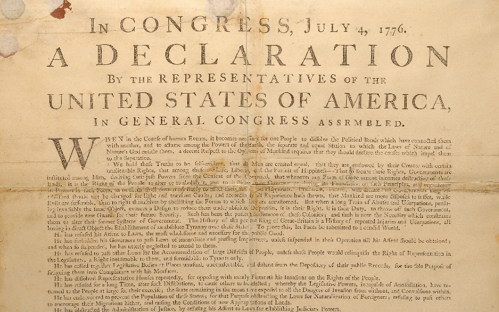
That the defeated Hessian was not exaggerating is echoed by the fact that then-British Prime Minister Horace Walpole told King George III and his cabinet that “there is no use crying about it. Cousin America has run off with a Presbyterian parson and that is the end of it!” Walpole was likely referring to Rev. John Witherspoon, the Scots Presbyterian minister from New Jersey, who was the lone pastor to sign the Declaration of Independence.
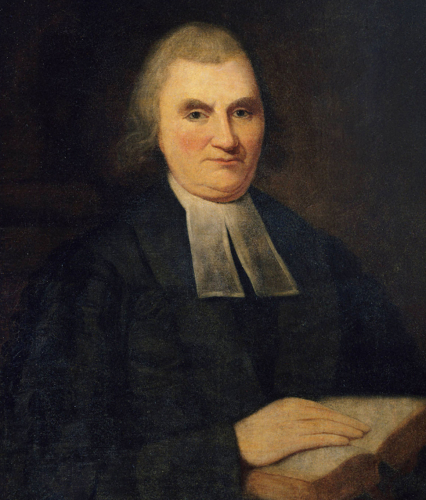
Witherspoon (pictured below) is by far the best-known of the many Scots and Scotch-Irish, who so influenced the laying of the groundwork for the revolution and then did much of the fighting that eventually won independence in 1781. In a May 1776 sermon, Witherspoon appealed that “God grant that in America true religion and civil liberty may be inseparable, and that the unjust attempts to destroy the one may, in the issue, tend to the support and establishment of both.”
In the same sermon, which went through nine printings and was read in London, Edinburgh, and throughout the colonies, he observed that “there is not a single instance in history in which civil liberty was lost, and religious liberty preserved entire,” and he declared that “the cause in which America is now in arms, is the cause of justice, of liberty, and of human nature.”
Rev. Samuel Davies, an influential Scots Presbyterian in Virginia, preached to multiple congregations there who dissented from the colony’s established Anglican church. Davies died a decade or so before 1776 but his influence was such that Patrick Henry would later credit much of his own oratorial prowess to Davis. Like Witherspoon, Davies served a term as President of Princeton, itself founded to serve and strengthen the Presbyterian influence in the colonies.
And it is no coincidence that the pastor who in revolutionary lore was said to have told his fellow patriot soldiers to “Give’em Watts, boys” was Rev. James Caldwell, another Scots Presbyterian from New Jersey, who was referring to the Isaac Watts hymnbook used through Protestant churches of the day. The soldiers thus tore out pages of the book to use as wadding for their musket power and balls, as ordered by their chaplain, the “Fighting Parson” Caldwell. Caldwell was a graduate of Princeton where he studied under multiple Presbyterian lights.
 There are two basic reasons why these preachers, whose roots stretched back to the shores, lochs, and Highlands of Scotland, as well as the Scotch-Irish Ulstermen of Ireland, were so prominent in the decades leading up and in the war for independence.
First, as Arthur Herman explains in his “How the Scots Invented the Modern World,” by the first decade of the 1700s, “Scottish merchants penetrated the Chesapeake Bay and the James, Potomac and Delaware rivers, and operated as far north as Boston. Scottish settlers started arrived as early as the 1680s and, as Britain’s role in North America expanded, the Scottish presence grew with it.” The Scots thus early on were ministers, farmers, doctors, lawyers, mechanics, teachers, tutors, and entrepreneurs in the settled coastal areas, especially in the Middle and Southern colonies.
Those Scotsmen made up only the first wave. The second wave began with a group of Ulster Scots who, according to Herman, were in Worcester, Massachusetts in 1713 “much in demand as Indian fighters and as a tough barrier between the English settlers and the wilderness.” Up to a quarter of a million of such Ulster Scots transplanted from Ireland to America between 1713 and the opening years of the American Revolution.
There was a third wave that came from the Scots Highlands beginning in 1729 along the Cape Fear River in North Carolina and then accelerating with the Argyll Colony in 1739. The Highland wave crested in the years after the defeat of the Jacobite Revolution that sought to restore the Stuart dynasty on the British throne.
This Scots invasion intensified as the Revolution approached, with 3,500 of them, for example, arriving in Philadelphia just in the first two weeks of August 1773. They were fiercely independent, long and well-schooled in arms of all kinds, and, thanks to the enduring influence of the Scottish Kirk from the John Knox Reformation, convinced believers in the absolute sovereignty of God, the accountability of all Earthly rulers to God’s law, and the liberty of every man and woman to live their lives according to how they understood Holy Scripture, without having any higher human authority telling them otherwise. For such folks, what Jesus meant when He said to “render unto Caesar what is Caesar’s and to God what is God’s,” He meant Caesar’s job was mainly to maintain peace and order.
And they tended to be restless, moving with some frequency and almost always further west into the Appalachian regions and beyond, deep into the Eastern interior of the North American continent. Thus, their cultural influence was widespread and, especially in much of the agricultural Middle Atlantic and throughout the South, decisive even up to the modern era, as seen in the language heard now daily.
To cite just a few mentioned by Herman, when people today say “whar” instead of “where,” “thar” rather than “there,” “wider” for “widow” and “young’uns” in place of “young ones,” they speak the language of the Scots, especially those from Ireland and Lowland Scotland. Two more examples are especially revealing, as the term “redneck” was originally used by Scots to describe a Presbyterian, and “cracker,” from the Scots word “craik” for talk, referred to a loudmouth or braggart.
Patrick Henry’s immortal words of “Give me Liberty or Give me Death” were uttered as the roar of cannon and the spilling of British, Hessian, and colonial blood was soon to begin in earnest, delivered on March 23, 1775, at St. John’s Church in Richmond in a soaring call to the colonies to fight for their liberties. None who heard Henry that day could be surprised as he had for more than a decade been among the most vocal advocates for resistance to the British Crown.
In the Stamp Act controversy, for example, it was Henry who said of measures passed in 1765 by the Virginia colonial legislature condemning the hated law, “whether they will prove a blessing or a curse will depend on the use which our people make of the blessings, which a gracious God hath bestowed on us. If they are wise, they will be great and happy. If they are of a contrary character, they will be miserable.”
 None of this went without notice in the home country. It was another Scot who saw never set foot in the colonies, but who nevertheless envisioned what could be the result. In his “Wealth of Nations,” Adam Smith wrote in 1775:
“They are very weak who flatter themselves that, in the state to which things have come, our colonies will be easily conquered by force alone. The persons who now govern the resolutions of what they call the Continental Congress, now feel in themselves at this moment a degree of importance, which perhaps the greatest subjects in Europe scarce feel.
“From shopkeepers, tradesmen and attorneys, they are become statesmen and legislators, and are employed in contriving a new form of government for an extensive empire, which, they flatter themselves, will become, and which indeed seems likely to become, one of the greatest and most formidable that ever was in the world.”
This is all not to say the American Revolution was entirely the product of Scots Presbyterian theology, political applications of that theology, and the impassioned culture and temperament associated with Scotland, but it is difficult to envision how the Declaration of Independence could have been conceived, written, and proclaimed without such influence.
As John Adams wrote to his old ally and opponent, Thomas Jefferson, in a letter of 1813, the Revolution’s body consisted of “Roman Catholics, English Episcopalians, Scotch and American Presbyterians, Methodists, Moravians, Anabaptists, German Lutherans, German Calvinists, Universalists, Arians, Priestleyans,Socinians, Independents, Congregationalists, Horse Protestants and House Protestants, deists and atheists. … Very few however of several of these species. Nevertheless, all educated in the general principles of Christianity, and the general principles of English and American liberty.”
But when Witherspoon and his fellow signers of the Declaration mutually pledged “our lives, our fortunes and our sacred honor,” it was with a spirit that recalled this promise from the Scots signers of the Declaration of Arbroath in 1320 declaring that “as long as but a hundred of us remain alive, never will we on any conditions be brought under English rule. It is in truth not for glory, nor riches, nor honors that we are fighting, but for freedom — for that alone, which no honest man gives up but with life itself.”
Americans celebrating our nation’s 250th anniversary would do well to recapture that same spirit.
Notice: This column is printed with permission. Opinion pieces published by AFN.net are the sole responsibility of the article's author(s), or of the person(s) or organization(s) quoted therein, and do not necessarily represent those of the staff or management of, or advertisers who support the American Family News Network, AFN.net, our parent organization or its other affiliates.