


The month of August marks six months of a stop-and-go foreign policy: Military attacks on Iran, then negotiations with its surviving leaders, and then more military attacks followed by more negotiations.
That back-and-forth White House strategy has been happening since “Operation Epic Fury” began in late February. Now Trump said on Sunday the U.S. is “semi-negotiating” with Iran.
 “Trump can't move forward and he can't move back. He is really caught,” Robert Spencer, director of Jihad Watch, told American Family News.
With high-stake midterm elections now under the 90-day mark, Iran’s leaders said over the weekend they believe the political leverage is on their side.
“They started the war, but its end was never with them. We always decide for ourselves when it ends," Mahdi Mohammadi, an adviser to Iran's chief negotiator, posted on social media. “Iran is going after the enemy’s defeat — not an agreement."
 That braggadocios tone differs greatly from Trump. He insists the United States has the real leverage because of economic pressure that is squeezing Iran’s regime of its vital oil revenues.
"We were going to a tremendous attack, the biggest since World War II,” Trump told Fox News last week. “And they called me and said, very politely, 'Please, can we talk?' They want to make a deal. We'll see what happens."
 The main negotiating tool appears to be the Strait of Hormuz. That crucial waterway, where 20% of the world’s oil flows, connects the Gulf of Oman and the Persian Gulf. The narrowest portion of the waterway is also Iran’s territorial waters, and the regime has used that control to its advantage for decades.
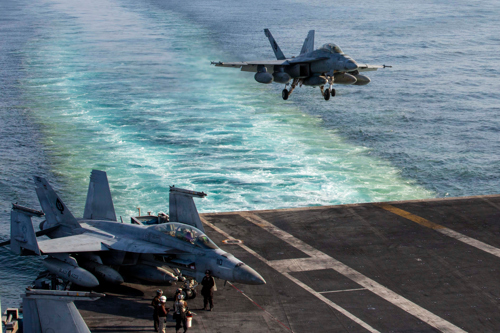
Over the past six months, the United States Navy has overseen a naval blockade called “Wall of Steel” that is located outside the Strait. A newer operation to escort commercial vessels began in May, but the Pentagon and White House have watched Iran attack civilian ships with mines and missiles despite the U.S. Navy’s vow to protect them under “Operation Project Freedom.”
Spencer, who has studied Iran’s regime for decades, says he knows where President Trump likely went wrong. He probably expected the death of Ayatollah Khamenei, who was killed in the first hours of “Operation Epic Fury,” would mean the regime would fall.

“It didn't fall,” Spencer said.
The U.S.-Iran situation right now, Spencer added, is really a picture of two different worlds. The nature of American politics is there's danger with an unpopular war in a nation where voters voice their opinion during Congress’ two-year election cycle.
“The Islamic Republic, meanwhile, considers itself to be fighting a jihad that has been going on for 1,400 years,” Spencer said.