


CIA senior operations officer James Erdman III testified before the Senate Homeland Security and Governmental Affairs Committee, revealing that analysts suspected a lab leak as the likely origin of COVID-19 in early 2020. However, these findings were reportedly omitted from official intelligence reports.
During the May 13 hearing, the CIA whistleblower explicitly stated, “Dr. Fauci’s role in the [COVID-19] coverup was intentional.” For many, this assertion now raises concerns about Fauci’s potential willingness to manipulate data regarding the efficacy of remdesivir, a drug used in the treatment of the virus.
Supporting this claim, Health and Human Services Sec. Robert F. Kennedy Jr. noted in his 2021 book, The Real Anthony Fauci, that the disgraced doctor “[moved] the goal posts” and created new endpoints to “[allow] the drug to demonstrate a benefit.”
Family members of veterans who passed away after receiving remdesivir have reached out to American Family News seeking to amplify their stories. Many reported being told that their loved ones died from respiratory failure, pneumonia, and pneumothorax due to COVID-19. However, research indicates what the families believe, that remdesivir can cause similar adverse effects, raising questions about its role in these fatalities.
In response to a 2025 Freedom of Information Act request from author J.M. Phelps, the Veterans Health Administration disclosed that out of 446,648 veterans diagnosed with COVID-19 in 2020 and 2021, 25,468 (5.7%) received remdesivir. Of the 446,648 veterans diagnosed with COVID-19, 18,888 (4.2%) died within 30 days. Among the 25,468 who were diagnosed, 4,014 (15.7%) were given remdesivir and died within 30 days.
This 15.7% mortality rate stands in stark contrast to earlier estimates from the World Health Organization, which suggested that only “about 3.4% of reported COVID-19 cases have died.” Further research has indicated that the infection fatality rate (IFR) was much lower, ranging from “0.002% at 20-29 years, 0.011% at 30–39 years, 0.035% at 40-49 years, 0.123% at 50-59 years, and 0.506% at 60-69 years.”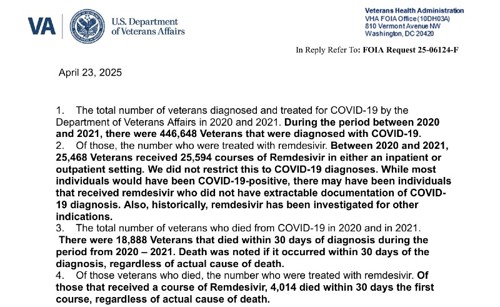
Given the low mortality rate of COVID-19, an important question arises: Would the lives of over 4,000 veterans have been lost if remdesivir had not been administered? This is the question for which many families are seeking the answer.
This troubling statistic did not go unnoticed. In 2024, another whistleblower emerged, much like Erdman, to address the use of remdesivir in treating COVID among veterans. He told The Gateway Pundit, “I don’t think anyone should be excused from a thorough investigation when their actions potentially resulted in the death and disablement of countless people who trusted in their decision making.”
 By analyzing data from the Department of Defense (DOD) Joint Trauma System (JTS), he found that 601 out of 941 (63.9%) patients treated with remdesivir between March 2020 and March 2024 did not survive. These results correspond more closely with the conclusion that remdesivir was linked to the highest mortality rate (53.1%) among participants in a trial of four experimental treatments for Ebola carried out in the Democratic Republic of Congo between 2018 and 2019.
This troubling evidence raises serious concerns about the safety and efficacy of remdesivir, particularly in light of its widespread use during the pandemic. The families of veterans who suffered tragic losses have been left grappling with unanswered questions, conflicting answers, the lack of informed consent, and a growing sense of urgency for accountability.
These revelations could severely undermine trust in the military healthcare system, potentially hindering recruitment and retention efforts within the military and veteran communities. With whistleblowers shedding light on potential cover-ups and alarming mortality rates, they say the call for a comprehensive investigation of remdesivir’s role in treatment protocols for COVID-19 has never been more critical.