


Michigan Democratic Senate candidate Abdul El-Sayed's links to the Muslim Brotherhood were brought to light when he ran for governor in 2018, and he has tried to keep them quiet ever since.
During his years at the University of Michigan from 2003 to 2007, El-Sayed served as vice president and president of the university's chapter of the Muslim Students Association, a national organization founded in 1963 by Muslim Brotherhood members.
In 2011, El-Sayed wrote an article defending U.S. support for Egypt's uprising against Hosni Mubarak, and in 2012, he was listed among 46 Egyptian-American community leaders who signed an open letter supporting Egyptian President Mohamed Morsi, a senior Muslim Brotherhood figure whose Freedom and Justice Party served as the organization's political wing.
His family has also been linked to the terrorist organization through statements by his half-sister, Eman Abdelhadi, who wrote on social media in 2012 that their family had a longstanding connection to the Brotherhood and described their biological mother's activism in the organization while attending college in Egypt in the early 1970s.
Republican Senate candidate Mike Rogers has criticized El-Sayed over campaign donations from individuals affiliated with the Council on American-Islamic Relations and the Islamic Society of North America, both of which were named as unindicted co-conspirators in the 2007 federal Holy Land Foundation terrorism-financing case, in which five foundation officials were convicted of providing material support to Hamas.
Now facing renewed questions about his relationship with the Brotherhood, El-Sayed has called his half-sister's social media posts "hearsay," and he has explicitly agreed to disavow the organization while denying that he ever had ties to it.
Earlier this month, when Kristen Welker of NBC's "Meet the Press" asked him to "set the record straight" about the Brotherhood, he responded with a simple "no."
"You don't have any ties, and your family doesn't?" Welker clarified.
"No," he repeated, framing his opponent's criticism as an attack on his "different" faith.
"Let me just stop you there," El-Sayed recently told Bret Baier when the Fox News personality tried to bring up the subject. "You are asking this question to raise a question about whether or not I have dual loyalty."
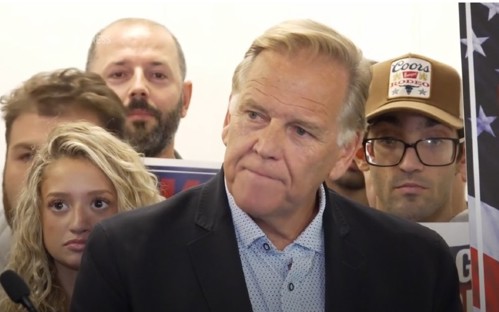 Over the weekend, Welker thought she had the ultimate "gotcha," asking Republican Mike Rogers about his own past with the Muslim Brotherhood.
"Do you acknowledge that at the time, in 2012, you were willing to work with some moderate members, as you said, of the Muslim Brotherhood?" she posed.
"That is so much out of [context]," he responded, adding, "I wish you would have done this for Abdul El-Sayed. That would have been a great interview."
The context Welker was ignoring, according to Rogers, was that his job in Congress at the time involved foreign affairs.
He explained that as chairman of the House Intelligence Committee, he was working to preserve intelligence cooperation between Israel and Egypt. The Muslim Brotherhood was trying to undermine those relationships, which he argued could have led to increased violence in the region.
He defended his 2012 statement as a national security decision made in the context of regional intelligence cooperation. His intention, he said, was not to endorse the Brotherhood's ideology.

Talk show host Richard Randall says Welker's question was a cheap shot and that she knew exactly what she was doing.
"There is no equivalency between El-Sayed and Rogers whatsoever," Randall asserts. "Rogers does some back-finding and feeling out of things; El-Sayed is absolutely supportive of this."
This is not the first time Welker has been criticized for what critics describe as biased journalism, in which she "carries" Democrats through interviews but confronts Republicans with "twisted" rhetoric.