


Bezos, the billionaire founder of Amazon, bought The Post and became its owner in 2013. That title is why he announced last week the newspaper's opinion pages will be focused on two important rights: personal liberties and free markets.
According to Bezos, opposing viewpoints will be left to other publications.
 David Shipley, the editor of the opinion section, abruptly resigned rather than lead a section that would focus on such things. Instead, he said he wants a "broader, pluralistic" opinion page in the Post.
Curtis Houck, of the Media Research Center, tells AFN the Post's editorial section is many things but "pluralistic" is not one of them.
"The Washington Post editorial board is largely indistinguishable from almost any other newspaper in the United States," Houck observes.
Roughly a half dozen other Post writers have also resigned over disagreements with Bezos’ direction since his purchase of the newspaper.
The Associated Press, itself known for liberal bias, began its coverage of Bezos’ decision last week by saying, “The billionaire owner of The Washington Post, Jeff Bezos, narrowed the topics covered by its opinion section...a pivot away from its traditional broad focus and prompting the news outlet’s opinion editor to resign.”
The problem is opinions from the Post have been anything but broad, Washington Stand editor-in-chief Jared Bridges said on Washington Watch Friday.
“The Left is upset because they’re not going to get to offer their viewpoint, which has pretty much ruled The Washington Post in the past,” he told show host Jody Hice. “When I first saw this thing, I thought heads are going to explode.”
 In stating that focus of the editorial section will become more rigidly defined, Bezos is simply describing a current reality that has been ignored by the Left, Bridges said.
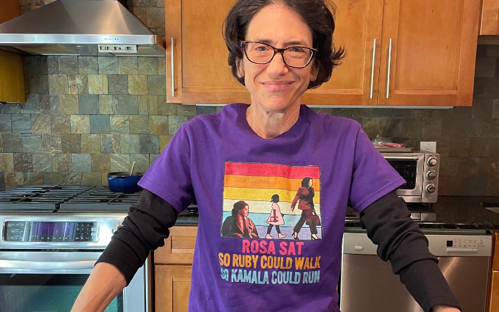
Former columnist Jennifer Rubin -- shown at left in a Kamala Harris campaign t-shirt -- was early in her career considered a conservative voice at The Post until later becoming a harsh critic of Donald Trump and a supporter of Joe Biden's administration. She left The Post in January.
“The liberal media has wanted this to be some sort of carousel of views … all views are welcome, and all views are supposedly equal. They’re not equal. The Washington Post hasn’t been offering a carousel of views,” Bridges said.
This is who we are and what we do
Now the newspaper will be much more forthcoming.
“Now they’re going to say, ‘here’s where we’re coming from. Here’s where we are,” Bridges said.
While conservatives welcome the change this isn’t about some grand awakening Bezos has come to entirely on his own, writes Rich Lowry for The New York Post.
It’s due in part to the election of Donald Trump and his White House policies, but it goes back farther to Trump’s new friend Elon Musk and Musk’s entry into the social media sphere.
“The president’s election — together with Elon Musk’s acquisition of Twitter — sent a cultural signal that it’s OK to defy woke employees and other forms of progressive social pressure.
 We’ve seen it in Meta’s turn toward a more free speech-oriented policy and Los Angeles Times owner Patrick Soon-Shiong’s efforts to shake up that paper,” Lowry writes.
Change for the opinion pages are a well and good, but they’re not the epicenter of the Post’s problems, he adds.
“The deeper issue is the abysmally biased news coverage that is part of a decades-long ingrained culture. Fixing that may be beyond the power of even one of our era’s most transformative agents of change. The furious reaction to Bezos speaks to the left’s intolerance of dissenting news sources,” he writes.
The Post has been “synonymous with crusading liberalism” since its famous Watergate coverage, Lowry said.
In the new day of journalism, it’s hardly unusual for a news outlet to take a stance, to outline its beliefs for its readers and let them know their coverage begins from a certain point of view.
But for a legacy news outlet, a brand like The Washington Post, to make that statement is outside the norm.
Today’s full-disclosure news sources
It may be a signal to the changing ways that readers consume the news.
Hice said The Washington Stand, the news outlet for Family Research Council, is a “powerfully influential competitor” to the Post is and is growing in readership.
The Washington Stand, like AFN, presents news from a Christian perspective.
“We publish news and commentary every day from a biblical worldview. That's where we're coming from. Our mission is to equip followers of Christ with truth and wisdom, so that so they can rest assured that they have the truth from a source they can trust,” Bridges said.
There’s no need to guess where The Washington Stand is coming from, Bridges said.
“We work through the issues with you, and we do that with news and opinion. We’re trying to do that from an avenue that doesn’t get as much play in the legacy media.”
Editor's Note: This story has been updated with comments from Curtis Houck.