



Meta has faced intense public accusations and scrutiny regarding child safety for about five years, beginning when whistleblower Frances Haugen leaked internal company documents to The Wall Street Journal that revealed Meta's own internal research showed Instagram negatively impacted mental health and body image for a significant portion of teenage girls.
The company has now agreed to pay $17 billion and add stronger child-safety measures to Facebook and Instagram platforms.
The settlement came just after a federal trial began in Oakland, California.
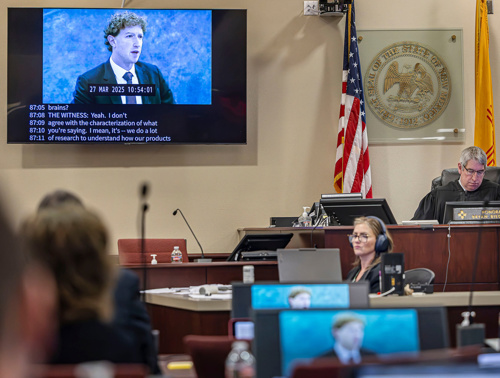 A bipartisan coalition of state attorneys general sued the parent company that owns and operates platforms like Facebook, Instagram, WhatsApp and Threads, claiming the company knew about and did nothing to prevent minors from getting addicted to social media.
"There are now a generation of kids who have lost sleep because of notifications and alerts all hours of the night, who performed less well in school because they were distracted and tired," said Colorado Attorney General Phil Weiser (D).
In some cases, young people even took their own lives.
"While Meta is certainly paying for its conduct, this was never just about the money," said Attorney General Russell Coleman (R-Kentucky) in a press release. "Kids deserve a childhood that isn't measured in likes and followers."
The settlement requires Meta to implement stronger, more user-friendly parental controls and immediate changes on Instagram and Facebook, including a two-hour daily time limit and mandatory "productive pauses" for children after 15 minutes of continuous use on Facebook and Instagram and again at 60 and 90 minutes to interrupt endless scrolling.
"Nighttime blocks" also restrict children's access from midnight to 6:00 a.m., and limited school-time access eliminates push notifications on weekdays from 8:00 a.m. to 3:00 p.m. during the school year.
Robust age assurance measures will be enforced to more effectively verify the age of young users, as will safer, age-appropriate content controls, including stronger safeguards against bullying, content promoting eating disorders, and content related to suicide and self-harm.
"The online protections delivered by this settlement will bring a generational change that will make social media platforms safer for Kentucky families," said Coleman.
 Attorney General Rob Bonta (D-California) said this was personal to him as a parent.
"I'm the AG of California, honored and grateful for that, but the most important title I'll ever have is dad to my kids," said Bonta (pictured right) in a press conference. "I am, as a dad, thankful that our AGs came together to deliver this."
Should other social media platforms follow Meta's lead?
Child safety experts emphasize that accountability does not stop with this settlement.
"What we really need is a broader industry trend with stronger safety standards as the floor," says Haley McNamara, executive director and chief strategy officer for the National Center on Sexual Exploitation (NCOSE). "When we think about it, enforced daily limits, nighttime restrictions, and stronger age assurance are still very basic expectations for safety or well-being online."
She says other major platforms will face growing pressure to step up.
"TikTok and YouTube are going to start receiving a lot of pressure to at least match Meta's standards," McNamara asserts. "I think that's a very good thing just to raise the bar across the industry."

While independent oversight of these important improvements is a welcome step, she adds that parents must stay actively engaged in monitoring their kids' digital experiences because the new measures do not make online spaces completely safe.
"It doesn't block off potential loopholes that just haven't been discovered yet," the NCOSE spokesperson points out, noting that "Meta has a history of rolling out safety standards that then don't work."
According to McNamara, about four-fifths of Instagram Teens' safety settings did not work in a test that was done earlier this year.
So while she is "very grateful" that there will be an independent oversight requirement to make sure that these are as effective as possible, McNamara reiterates that parents "still have to keep our hands on the wheel and stay engaged with our kids' online experience."