


Throughout his years, George Washington made many remarks in his speeches that referenced or acknowledged God.
"Of all the dispositions and habits which lead to political prosperity, religion and morality are indispensable supports," said the first president of the U.S. in his famous "Farewell Address."
Although it was not implemented, Benjamin Franklin called the Constitutional Convention, after weeks of disagreements, to partake in daily prayer. In his famous "Prayer Speech," he noted that "God governs the affairs of men."
 The First Amendment of the Constitution says that the Congress can make no law establishing a religion or prohibiting those from exercising their faith. This amendment, authored by James Madison, is a part of the Bill of Rights, designed to keep the government from interfering on personal liberties.
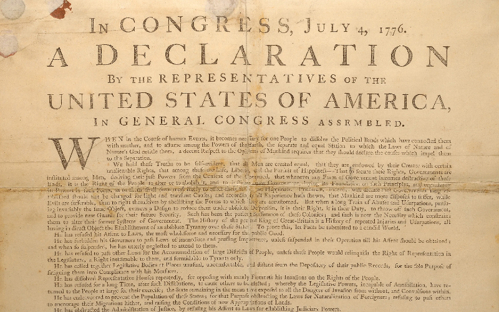
Before the Bill of Rights, the Declaration of Independence informed an English king where mankind's freedoms and basic rights originate. In the document, there are four direct references to God:
1. the separate and equal station to which the Laws of Nature and of Nature's God entitle them,
2. endowed by their Creator with certain unalienable rights,
3. appealing to the Supreme Judge of the world for the rectitude of our intentions, and
4. with a firm reliance on the protection of divine Providence.
July 4, 1776 is the day delegates representing the 13 colonies cast votes to adopt that document written to King George III.

Christian apologist Dr. Alex McFarland warned on American Family Radio (AFR)'s "Today's Issues" program that a free government simply cannot survive without what he calls a baseline of objective morality.
"This is not the gospel. The gospel is believing in Jesus who paid for our sins on the cross, but just basic morality, that our Constitution is just not even operable or enforceable in a moral vacuum," McFarland states.
Long before McFarland made that observation, Johns Adams made a similar observation in a 1798 letter to a Massachusetts militia. "Our Constitution was made only for a moral and religious People. It is wholly inadequate to the government of any other," he wrote.
 "I've been talking about how the breakdown of the family, no legal protection for the unborn, and now really the denial that male and female even exist… all of these things conspire to make our culture ignorant of objective morality," he said.
McFarland urged listeners to restore a biblical worldview within the home, the church and at the ballot box, to preserve America's constitutional republic.