



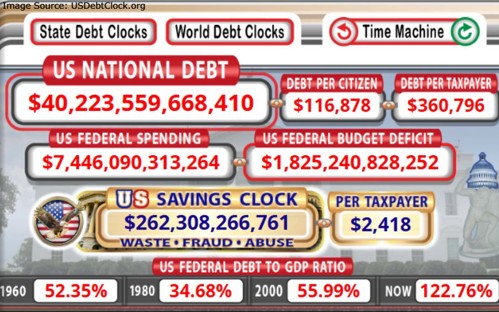
Looking at the U.S. Debt Clock, the country has surpassed $40 trillion in the national debt.
Ross Marchand, executive director of the Taxpayers Protection Alliance, warns that the red ink is piling up faster than ever.
“We are in debt, and we are in debt to the tune of $40 trillion. This is a completely unacceptable figure, and it’s a $117,000 tax on every man, woman, and child in the United States,” Marchand says.
The crisis, he emphasizes, isn't caused by a lack of tax revenue, but rather by runaway government spending.
“This is a spending problem because in the past 10 years, tax revenue has increased significantly by 50%,” Marchand states. “It's just that spending has picked up a lot more than tax revenue has.”
Taxpayers Protection Alliance has released a new report “As National Debt Tops $40 Trillion, TPA Unveils $10 Trillion Spending Cut Blueprint." It details 40 specific ways to cut spending.
Addressing the problem will require cooperation from both sides of the aisle to tackle major budget drivers — including defense contracts and entitlement programs, he says.
“This is very much a bipartisan problem, and it will take bipartisan solutions to get out of this debt,” Marchand says. “Cracking down on fraud would make a huge difference, especially in government-funded health insurance programs like Medicare and Medicaid.”
He then turns to U.S. Department of Defense (DOD) cuts.

“For example, the F-35 fighter jet program is up to its knees in debt and will cost $2 trillion over the lifetime of the program. (Getting) the F-35 program under control, and reining in on contract abuse at DOD (U.S. Department of Defense), is going to save at least $200 billion a year,” Marchand states.
However, he points to Social Security as the biggest program by outlay in any given year.
 “Any reform needs to address Social Security. To that end, households should not be getting six figures in Social Security benefits in any given year. Cutting that out will save another $200 billion,” Marchand says. “Not eliminating Social Security benefits, but getting Social Security benefits under control and making sure it's there for future generations.”
Ultimately, Marchand frames the fiscal crisis not just as an economic headache, but as a critical danger to the nation’s future.
“Make no mistake: National debt is the number one existential threat to the country,” Marchand warns.