



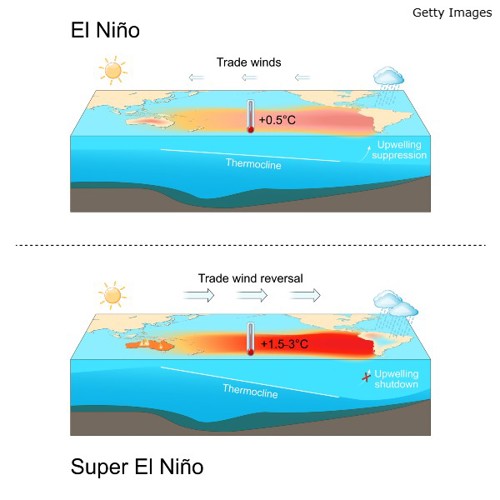
Water temperatures in the region of the equatorial Pacific known as Niño 3.4 — where forecasters monitor the strength of El Niño — have climbed to 2°C above average, meeting the threshold for the designation.
A Super El Niño will have a big impact on this winter, causing more storms and rainfall in the southern tier of the U.S. and above-average temperatures in the northern tier.
The polar vortex could come into play as well and bring cold air into the U.S. And meteorologists are wondering if El Niño is strong enough to push back the polar vortex.
Fox Weather covered the developing situation of the Super El Niño with their meteorologists Ian Oliver and Haley Maier.
Oliver referred to the Super El Niño as an "atmospheric bully" that has been "calling the shots" globally.
"The intensifying El Niño has snatched up autumn's lunch money with above average temperatures so far this season for almost the entire country," Oliver said. "What we're expecting to be later this week, the earliest polar vortex disruption on record, it isn't going to do anything, by all accounts, because of the Pacific air that just dominates the country."
Mainer said that when the polar vortex weakens, it doesn't always lead to cold air outbreaks.
"About 63% of polar vortex disruptions brought this cold surge. El Niño is the big bully of it all," Maier said.
Frequent precipitation, lots of cloud cover across the southern U.S. are expected to keep daytime temperatures below average thus the description of cooler and wetter.
According to the Climate Prediction Center, the El Niño will continue to get stronger, especially through January to March of 2027, and will not weaken until then. There is a 60% chance during the October-December and November-January periods for historic conditions will exceed previous El Niño's since 1950.