



Bryan Johnson made millions in the early 2000s buying and selling web payment systems, but lately, he has been spending his time trying to live forever.
To that end, he posted on X that he has cloned himself as a newborn — a baby-Bryan that lives in a petri dish and will eventually be used for blood transfusions, medical testing and eventually the source of replacement organs for his aging self.
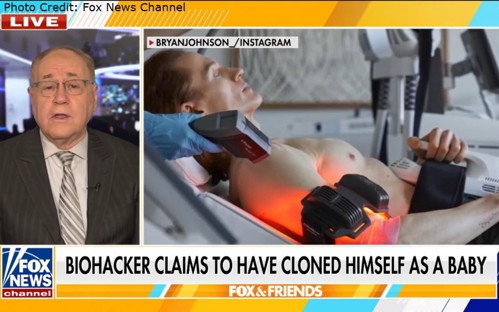
According to USA Today, Johnson announced in June that he has been diagnosed with autoimmune gastritis, which he now strives to find the cure. He credits his cloning finds to his diagnosis, saying this is an example of how it opened a new frontier to “repair and strengthen the body.”
He also claims that clinical trials are already using this technology and that this is the path to reverse aging.
Dr. Marc Siegel, senior medical analyst for Fox News, says that he's done nothing of the sort. He was questioned on Fox & Friends if cloning oneself is even possible.
“No, I'm a fan of some biohacking, and I think Brian Johnson is out there. We like to say in medicine that today’s experimental treatments are tomorrow’s cure, but this is impossible,” Siegel says.

As he explains, researchers have been successful at cloning animals like sheep, but once they tried making other primates, they hit a brick wall.
“It doesn't work when you start trying to then grow yourself out of it. It makes all kinds of mistakes, all kinds of problems. You're going to have all kinds of diseases. Not only isn't it ethical, but it doesn't work,” Siegel states.
Johnson may be able to use, he says, the clone for research or maybe blood transfusions, but that's about it.
“We might be able to use it for medical purposes. We're not going to be able to clone ourselves. Our DNA and our genetics don't want us to,” Siegel states.
He mentions AI is making huge strides in medicine and will continue to find cures and maybe even extend lives to a certain point.
“He's talking science fiction right now, and he's not doing himself or the public any service saying that that's a baby. Maybe it's an AI, maybe it's a robot, but it ain't a real person,” Siegel says.