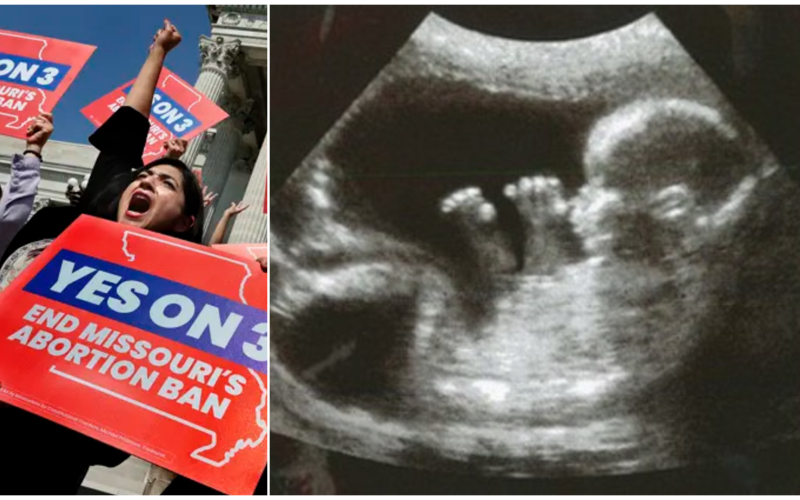



Voters in four states are weighing in on abortion-related ballot measures today. Idaho, Nevada and Virginia are voting on measures to establish or expand legal protections for abortion and other so-called reproductive rights, while Missouri voters are considering an amendment that would overturn a 2024 constitutional amendment and prohibit most abortions in the state, with exceptions for medical emergencies, fetal anomalies, rape and incest.

In Virginia, state law currently allows abortions up to nearly 27 weeks, but Kelsey Pritchard of Susan B. Anthony Pro-Life America says the abortion lobby and Democrats want to "allow abortion later than that in the second and third trimesters — and essentially until birth."
Proposed Constitutional Amendment Question 1 asks, "Should the Constitution of Virginia be amended to (i) protect the freedom to make personal decisions about prenatal care, childbirth, postpartum care, birth control, abortion, miscarriage management, and fertility care; (ii) protect doctors, nurses, and patients from being punished for these decisions; and (iii) allow for restrictions on access to abortion during the third trimester of pregnancy except when the patient's health is at risk or the pregnancy cannot survive?"
In response to the U.S. Supreme Court ruling in Dobbs v. Jackson Women's Health Organization in 2022, the amendment would establish a constitutional right to abortion and restrict the state's ability to regulate reproductive decisions.
Proponents argue that the proposal would make few practical changes to existing abortion law. It would permit third-trimester abortion regulations but require exceptions when a physician determines an abortion is medically necessary to protect the pregnant woman's life or physical or mental health, or when the baby is not considered viable.
Pritchard, however, warns that the question is deceptively worded on the ballot to confuse voters so that they do not realize that the proposition, among other things, directly threatens parental notification laws across the state.
"If your daughter is not old enough to go get her ears pierced on her own, she could go get an abortion without ever telling mom or dad," the pro-lifer summarizes.
The most visible elected opponents to Virginia's Question 1 amendment have been Republicans, including Senate Minority Leader Ryan McDougle and former Lt. Gov. Winsome Earle-Sears. Some medical professionals and advocacy groups also oppose the amendment on grounds that its language is too broad or could affect existing safeguards.
Although no prominent Democratic state leaders have publicly opposed the measure, Pritchard believes opposition cuts across party lines. She argues that average Democratic voters do not share the far-reaching stance of Gov. Abigail Spanberger, House Majority Leader Charniele Herring, state Sen. Jennifer Boysko or Senate Majority Leader Scott Surovell.
"Late-term abortion is not something that's widely supported, and neither is taking away parental rights," Pritchard asserts.
Polling is limited and dated, but the most recent public survey, conducted in January, showed substantial support for Virginia's Question 1 amendment. When Christopher Newport University's Wason Center polled 807 registered voters Jan. 13-20, 66% supported the amendment, 28% opposed it and 6% were undecided.
On Point Politics' Nov. 2 forecast projects the amendment will pass comfortably, estimating a 71% yes vote and a 29% no vote. Its model gives the amendment a 98.7% chance of passage.
Since the Dobbs decision, voters across the country have approved constitutional amendments in 10 states codifying the right to abortion access while rejecting them in three. Should Question 1 pass, Virginia would replace Maryland as the southernmost state to enshrine the right to reproductive freedom in its constitution.
Pro-life advocates are urging all voters — especially faith-based voters — to make their voices heard, warning that the outcome in Virginia could serve as a national model.
Viewing ballots through a biblical lens
Joseph Parker, an ordained pastor who recently authored an article titled "Life and the Litmus Test," argues that standing up for the unborn is more than a political choice; it is a spiritual responsibility.

"Everything really is spiritual in the truest sense of the word, and the fact is every issue is a discipleship issue," he submits, encouraging believers to consider how to honor God in all matters, including voting.
He says the influence Christians have through the vote allows them to bear upon elections "in a kingdom way."
"When believers don't vote, we're neglecting to honor God through this opportunity we're given," Parker states.
In today's elections that will determine control of Congress for the remainder of Donald Trump's presidency, Parker's article asserts that a candidate's stance should serve as a primary "litmus test" for believers.
Citing the Sixth Commandment, Parker emphasizes that protecting innocent life takes priority over every other issue; failure to defend the unborn can carry severe moral consequences.
"Scripture is very clear," he says. "In a sense, this commandment has the greatest … consequences, because we're talking taking another human being out of this world at the whim of another human being."
Parker encourages voters not to stay home or discount their influence, calling the ballot box a key opportunity to honor God and advocate for the most vulnerable.
"Without question, I think taking and sharing an article like this can help people understand it from a biblical and a kingdom perspective, like we as mature believers need to understand it," he concludes.