



The new law, which was singed by Gov. Maura Healey (D), eliminates statutory restrictions on abortions past 24 weeks, allowing doctors to perform late-term procedures based on their professional medical judgment.
Bill sponsor State Rep. Lindsay Sabadosa (D) says it removes barriers to necessary care.
However, Fox News reports nine House Democrats broke ranks to vote against the bill, joining with Republicans, saying it was "extremist" and unnecessary given existing exceptions.
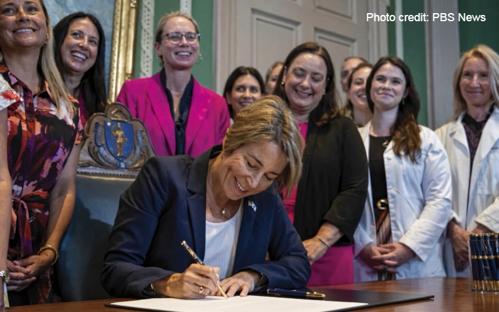 Dissenting lawmakers called the law "barbaric" and warned it sets a slippery slope, noting that prior state law already allowed late-term abortions to protect a mother's life or in cases of severe fetal anomalies.
The growing division within the party is catching national attention.
Michael King, president of the Massachusetts Family Institute, says while Republican opposition was expected, the Democratic split largely reflects election-year politics in more conservative districts.
"There are a lot of Democrats in conservative areas of Massachusetts. So, I'm sure to some extent this is a vote to kind of save them in their more conservative areas of the state," King says.

Kristen Day, executive director of Democrats for Life, says watching the celebration surrounding the bill's signing was deeply unsettling.
"To me, it's just really, really sad to see women celebrating the death of babies. We're the ones who are supposed to be protecting ... and they were celebrating and laughing and smiling, and it was disturbing. It was really, really disturbing," Day says.
For Day, seeing rank-and-file Democrats in Massachusetts break ranks to oppose the expansion was a rare but welcome sight.
"I'm always encouraged to see Democrats speak their conscience and speak the truth — too many of them feel like they can't do it. And so, yes, it's very encouraging to see people push back against this really extreme abortion measure," Day states.

With Massachusetts removing gestational boundaries, King cautions pro-life advocates across the nation against assuming their local protections are permanently safe. He points to recent voter outcomes in states like Kansas and Ohio following the Supreme Court's overturning of Roe v. Wade.
"You'd like to think that any state in the nation is safe, but I think just looking at those two examples of Kansas and Ohio should make anybody take pause and say, ‘Okay, like we definitely need to be aware and be involved.’ Never take anything for granted," King says.
Day also warns voters in other regions against assuming their state laws are permanent — pointing to out-of-state funding driving similar initiatives across the nation. She noted that nine other states and Washington D.C. have no statutory gestational limits.
 "People should be wary and pay attention and look for these — the money from out of state coming in to pass these abortion initiatives. I think people should really pay attention and not be afraid to speak up for the protections of women," Day says.
As similar battles loom on ballots in states like Virginia this fall, the rift in Massachusetts highlights an escalating fight over the future direction of pro-life policy nationwide.
In a state heavily dominated by one party, King believes the path forward for pro-life advocates goes beyond statehouse lobbying, arguing that the passage of this law is driving new candidates to step forward and challenge incumbents.
As King recounts, a father said, “Look, once I saw Gov. Healey signing this horrific bill and all these people around her so giddy about this particular signing. I said enough is enough. I'm running for office.”
King says his group believes that lawmakers have politically overstepped with the new law and is encouraging local citizens to get involved in local races ahead of the fall elections.