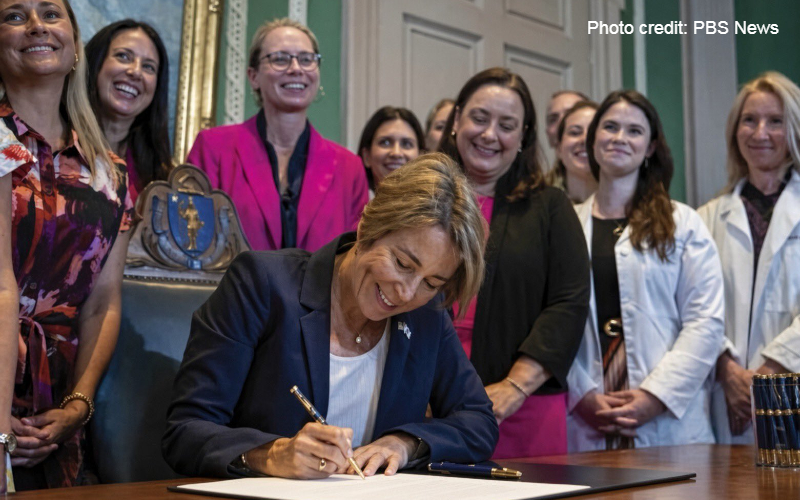

When the so-called "Prioritizing Patient Access to Care Act" takes effect in 90 days, Massachusetts will become the 10th state in the U.S. to put no gestational limit on abortion.
Calling the celebration inside Gov. Maura Healey's (D) office "ghoulish," C.J. Doyle of the Catholic Action League of Massachusetts says his state's new normal is "savage violence under the color of law."
Myrna Maloney Flynn, who leads Massachusetts Citizens for Life, likewise told American Family News earlier this week that it was "sickening" to see women celebrating abortion at the bill signing Wednesday.
Proponents of the law argue that the change gives healthcare providers the flexibility to evaluate a patient's circumstances, but pro-life activist Frank Pavone highlights a critical shift in the text itself — swapping the word "medical" judgment for "professional" judgment — which he recently told American Family Radio effectively opens the door to elective procedures at any stage.

"The physician doesn't any longer need a medical reason," he summarized. "He or she can simply say, 'This woman has so many social hardships. She has anxiety. She's healthy, and the baby's healthy, but in my professional judgment, she should be allowed to have the abortion.'"
Pavone also reflected on how political messaging around the issue has transformed over the decades. He noted that the mainstream pro-choice platform has shifted significantly away from the "safe, legal, and rare" framework popularized in the 1990s.
The people rallying for abortion on demand and without apology were the fringe of the movement when he started full-time pro-life leadership in the '90s, but now, he said they are the mainstream of the pro-abortion side.
"They don't want it rare," Pavone asserted. "They want no limits. They want it delivered on a silver platter by express train."
Meanwhile, he does not think most Americans believe that abortions should be legal, especially in the third trimester.
"Most Americans would have never favored abortion, even beyond the first trimester, let alone beyond the second," Pavone told show host Jenna Ellis.
He is calling on pro-life physicians in Massachusetts to use that same "professional judgment" standard to refuse late-term procedures, arguing that performing them violates the oath they took "to do no harm."
Reasoning that the medical field is supposed to be a healing profession, he does not see why a physician's professional judgment should find no medical indication for killing babies who can feel pain.
A call for more oversight
Meanwhile, a case out of Durham, North Carolina, is fueling intense debate over the safety and regulation of mail-order abortion drugs.
Abortion is legal in the Tar Heel State through 12 weeks and 6 days of pregnancy. After that time limit, the procedure is banned, though specific exceptions and regulations apply
"North Carolina law protects unborn babies from 12 weeks on, with exceptions for rape, incest and saving the life of the mother," Susan B. Anthony Pro-Life America President Marjorie Dannenfelser told The Christian Post. "Shipping abortion drugs through the mail is illegal."
Authorities have charged a young couple after an 18-year-old woman allegedly took abortion medication at 31 weeks of pregnancy — well into her third trimester.
The newborn reportedly remained in the toilet for an extended period before 911 was called. First responders found the prematurely delivered infant with a pulse and rushed him to a nearby hospital, where he survived and is continuing to receive medical care.
Pro-life advocates say the case exposes severe blind spots created by deregulation.
Since the FDA permanently lifted in-person dispensing requirements for abortion pills in 2021, patients have been able to receive the medications through the mail without seeing a clinician face-to-face.
Talking about this on the "Washington Watch" program, Dr. Christina Francis, CEO of the American Association of Pro-Life Obstetricians and Gynecologists, said the incident in Durham highlights a complete breakdown in medical oversight.
She also pointed out that a baby born at 31 weeks of pregnancy can survive with medical support outside of mom "nearly 100% of the time."

While the FDA has approved abortion pills only up to 10 weeks of gestation, Dr. Francis warned that taking these drugs late in a pregnancy poses severe physical dangers to the mother — particularly due to increased blood flow to the uterus in later stages.
There is a higher risk of hemorrhage and a high risk that the mother will not deliver the placenta, which can also lead to a need for emergency surgery and the need for blood transfusions.
Francis argued that without physical exams or ultrasound verification of gestational age, mail-order distribution systems fail to protect vulnerable patients, and that is why she is urging federal officials to reinstate strict protocols immediately.
"We need to hold this administration accountable," she implored, pointing out that they could put a stop to this "tomorrow by reinstating that in-person dispensing requirement."
In the meantime, faith leaders and community groups are being called on to expand local support networks for young women facing unexpected pregnancies.
The Church's failure
Massachusetts is considered strongly Catholic, but the state has become a distribution hub for the drugs used in chemical abortions, which accounted for about 65% of U.S. abortions in 2023.
Doyle says the church fell down on the job on this one.

"People are very disappointed with the Catholic hierarchy and with the official church response," he tells AFN. "There was a letter from the Massachusetts Catholic Conference, but it was never publicized."
Considering that New Jersey and New Mexico — two of the other states that have no abortion limits — are also strongly Catholic, Doyle is encouraging the Catholic Church and Protestant pro-lifers to engage.
"There has to be a reckoning over the fact that the pro-life movement is really being kind of betrayed by the leaders of the church," he submits.