






The midterm take down of President Donald Trump’s policies was somewhat like Richard Nixon the 1970s but not completely. It had elements of Bill Clinton and Al Gore in the 1990s but not entirely.
But wholly, it was a statement. Americans who ushered Trump into office just two years ago with 312 electoral votes — 42 past the 270-vote victory threshold — and almost 2 million more popular votes than Kamala Harris, told the president what he could do with high prices and affordability.
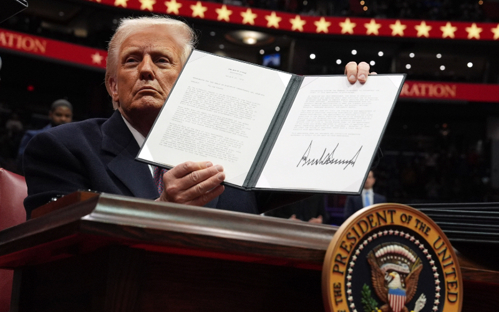 So angry were American voters that Diversity, Equity and Inclusion (DEI) and transgender initiatives, outlawed by Trump, were not a consideration for the majority of ballots as voters handed power to the party that prefers such things.
“In its scale and breadth, it is Watergate 1974. But remember, Richard Nixon was driven from office by then. He had resigned a few months before the election,” Steve Deace, the Blaze Media host, told AFR’s Jenna Ellis.
“The economy is not doing well right now, but it’s not the economy of the ’70s. My point being is, there's not a singular organic galvanizing moment that would cause this level of turn,” Deace said.
So, while the scale of the rebuke looks like 1974, the message resembles 1994.
 Clinton and Gore made the economy the centerpiece of their campaign. Once in office, Clinton pushed to raise taxes and pursued a liberal social agenda.
In August of 1993 Clinton signed the Omnibus Budget Reconciliation Act. It raised the top individual income-tax rate from 31% to 39.6%, increased the corporate income-tax rate, increased fuel taxes and increased the portion of Social Security benefits that were subject to taxation for some recipients.
It passed the House 218-216 without a Republican vote. It passed the Senate 51-50 with Gore providing the tie-breaking vote.
Clinton’s not-so-moderate turn
Socially, Clinton rescinded Reagan-Era abortion restrictions, allowed the importation of the abortion drug RU-486, and vetoed legislation in 1996 that would have banned partial-birth abortions.
He also championed gay rights with his “Don’t Ask, Don’t tell” policy to end the prohibition of homosexuals in the military.
In September of 1993 he introduced “Hillarycare,” the name applied to the White House initiative engineered by his wife, Hillary, which would have given the government excessive control of healthcare.
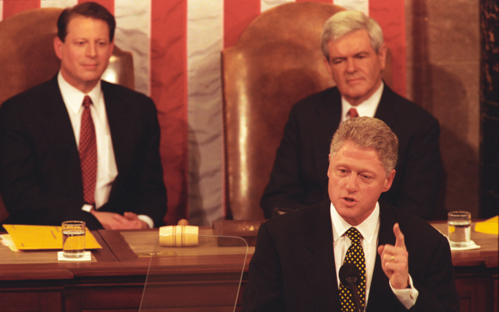 A year later, Senate Majority Leader George Mitchell acknowledged that it lacked support to pass.
When the midterms came around, the GOP gained 54 seats in the House, nine in the Senate, in what became known as the Republican Revolution. Republicans had control of both chambers for the first time since the 1950s.
Clinton and Gore were elected, and “they then turned around, raised taxes, did a massive, what Rush (Limbaugh) called at the time, a 'porkulous package,' which was just a handout to labor unions and other left-wing social causes and cultural groups. And then they attempted just outright socialism with Hillarycare and got absolutely annihilated and destroyed by the people in the next midterm election for it. They betrayed what they had run on,” Deace said.

Now the similarities are striking. Deace credited Trump for a 20% drop in the murder rate and for securing the border.
However, Trump not only failed to fix affordability issues he inherited but began a war that complicated things further.
“From a strategy standpoint, it made it very hard for us to pivot and say, ‘we need more time to fix this problem we inherited when we did something that made the problem we were hired to fix comprehensively worse across the board,’” Deace said.
The way out
But there’s a way out. It won’t be fast or easy, and it will require Americans to get out of their comfort zones, maybe run for a local elected office.
“We can’t just roll over. We’re the people of the stone is rolled away. We're going to America harder. We're going to go to church harder. We're going to pray harder. We're going to listen to the sermon harder. We're going to repent harder.
“You’re going to work hard, love your spouse and kids harder. Everything you were previously doing, you’re going to do harder,” Deace said.


