


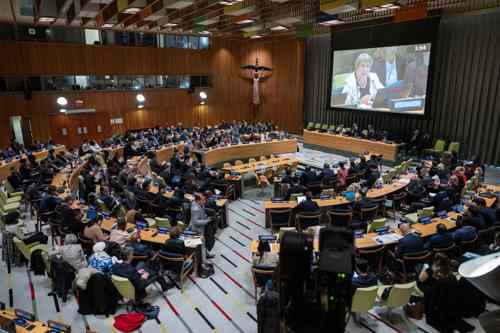
On Tuesday, during the annual United Nations General Assembly debate and vote on whether to condemn the United States' economic embargo against Cuba, U.S. Ambassador Michael Waltz got into a heated exchange with Cuban diplomats after quoting Ronald Reagan's 1979 remark, "There are supposedly communist classless societies," to highlight what he described as the corruption and hypocrisy of the Cuban regime.
 Waltz used the quote as a prelude to expose the immense wealth amassed by the island's elite while ordinary Cuban citizens face severe shortages. Photos and other evidence presented during the debate highlighted his argument that Cuba's economic hardships stem from internal corruption and kleptocracy rather than the U.S. embargo.
Cuban Foreign Minister Bruno Rodríguez Parrilla, meanwhile, used an on-screen live tracker to display the millions of dollars the embargo is costing Cuba. He accused the U.S. of pursuing a "maximum pressure policy" and waging an economic war that was strangling the island's health and energy systems.
The exchange sparked a dramatic confrontation on the U.N. floor, with members of the Cuban delegation attempting to rush the podium and shout Waltz down.
"I know you don't like to hear this," Waltz said to the Cuban ambassador. "This is America, my friend. This is the United Nations. This isn't your communist dictatorship. You cannot silence me, or you cannot silence my colleagues. He's not going to intimidate me in the United States of America like he tries to intimidate political prisoners. Back up, Ambassador. Back away. This isn't Havana."
As the shouting escalated, Dr. Khalilur Rahman of Bangladesh, president of the U.N. General Assembly, banged his gavel and officially suspended the meeting to restore order.
Cuban diplomats were directed back to their seats during the brief recess. When the meeting resumed, Parrilla was allowed to issue a formal point of order, openly protesting Waltz's claims as "uncivilized" and "crude" lies. Waltz then concluded his presentation and urged member states to vote against the anti-embargo resolution. No further major incidents occurred during the debate.
Humberto Fontova, whose family fled communist Cuba in 1961, says it was "immensely gratifying" to see someone stand up to the island's leaders.

"For decades, since day one of [Fidel] Castro's takeover, they have gotten away with the most blatant propaganda," he asserts. "Here … for the first time that I can recall, we see a flat-out rebuttal: 'No, we're not going to accept your lies here. You can't do this.'"
Cuba's government prohibits political dissent. Political participation is restricted to members of the ruling Communist Party, while independent political parties, labor unions and media organizations are illegal. The state uses legal frameworks, surveillance and law enforcement, including prolonged imprisonment, to suppress criticism.
Tuesday's confrontation also underscored heightened geopolitical tensions between the two countries. The day after the meeting, the Trump administration ordered the expulsion of a Cuban diplomat from the U.S. over an alleged assault on an American diplomat outside the chamber following the heated exchange.
The annual vote on the U.S. embargo has taken place 34 times. This year, the 193-member General Assembly voted overwhelmingly to pass the nonbinding resolution calling for an end to the decades-long embargo, with 130 votes in favor, 17 against and 25 abstentions.
However, the U.S. pressure campaign led to a historic 20-year low in support for Cuba, with Western nations such as Germany and Italy abstaining for the first time.