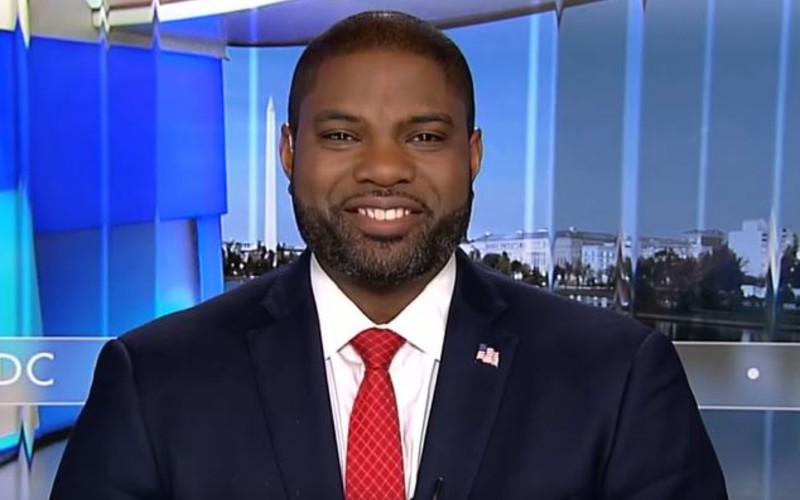



He’s spending a lot of time on the road right now campaigning with Republican candidates in swing districts. In the meantime, he’s gotten a little advice from a veteran of the political battles.
“I was having a conversation with Newt Gingrich, who’s still one of the great historians of Congress, the strategist of our party,” Johnson told “Washington Watch” host Tony Perkins over the weekend.

Gingrich remains best known for leading historic GOP success in the 1994 midterms, becoming Speaker after Republicans — united behind voter dissatisfaction with the agenda of Democratic President Bill Clinton — gained 54 seats in the House and eight in the Senate to control both chambers.
The election was widely dubbed the “Republican Revolution.” Rather than running hundreds of separate congressional campaigns with mostly local messages, Republicans nationalized the election around a common agenda.
In the run-up to the elections, Republicans unveiled their “Contract with America,” which promised 10 major pieces of legislation brought for a vote on the House floor within the first 100 days of Congress.
The central theme was lower taxes, less regulation, welfare reform, tougher crime policies, stronger defense and greater accountability for Congress.
These midterms are different, Gingrich told Johnson.

“’You made a lot of promises and you've kept them. So, you've got a great record to run on.’ He said, ‘This isn't a Contract with America year. This is a contrast for America year,’” Johnson said.
Increased socialist viewpoints within the Democrat party makes the contrast sharper than ever before, Johnson said.
The result is a host of candidates whose policy goals are substantially to the left of the traditional Democratic establishment.
These candidates typically prefer much larger government, less law enforcement influence — the abolishment of Immigration and Customs Enforcement (ICE) being the main talking point — Medicare for all, government intervention in housing, higher minimum wage, the end of support for Israel and much, much more.
The struggle for Democrats
It’s led to in-fighting within the party.
Moderate Democrats such as Rep. Tom Suozzi (D-New York) are explicitly pushing back, saying Democrats should improve capitalism rather than abandon it. House Democratic Leader Hakeem Jeffries (New York) has likewise said he wants capitalism to work better for working-class Americans.
“We should remain fiercely proud of the American system. It has enabled the quest for ‘a more perfect union,’ making possible the abolition of slavery, the rights of women and black Americans to vote, the protection of civil rights, the confrontation of religious, ethnic and racial bigotry and so much more,” Suozzi writes.
Whether Democratic moderates can quell the socialist uprising is a story being written in large part through this summer’s primaries. For the socialists, there have been some wins, some losses.
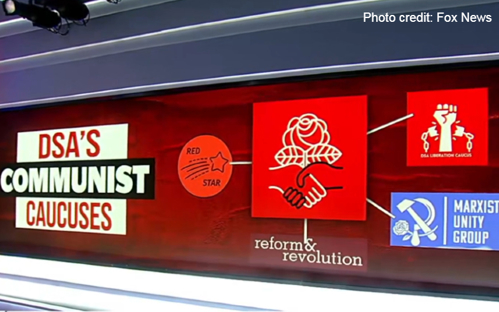
At the moment, rough estimates in a fast-changing count show 15 Democratic Socialists of America-backed candidates have advanced in U.S. House elections. Fourteen have lost.
In Florida, socialist candidate Oliver Larkin is on the ballot today.
“The way Newt crystalized it, he said, ‘it’s a contrast, to put it simply, between common sense and crazy,’” Johnson said.
Johnson, as the campaigner working to illustrate the Republican message, has modified Gingrich’s take on the Democrats in 2026.
“It’s a stark contrast, but it’s not just a contrast between common sense and crazy. It’s a contrast between common sense and communism. Communism is what we’re facing now, incredible as it is, on the 250th anniversary of the greatest nation in the history of the world,” he stated.
It’s a contrast 250 years later, Johnson said, that brings America back to a time when the curious Mrs. Elizabeth Willing Powel, a prominent Philadelphia citizen, inquired about the progress the Founding Fathers were making in hammering out her future government.
“Well, Doctor, what have we got, a republic or a monarchy?” she asked.
“A republic, if you can keep it,” Ben Franklin is said to have replied.
The dark, dangerous, deadly road
Johnson called the midterms a “truly fateful battle.”
“Are we going to maintain our matchless constitutional republic, or are we going to tear down the foundations, as the Democrats are arguing to do, and get rid of all the institutions and everything that have represented the country?" Johnson asked. “Are we going down the dark, dangerous, deadly road of communism? That is the choice for Americans, and they’re beginning to see that.”