


Before the high court’s decision last week in Louisiana v. Callais — which held that the state’s use of race to draw its congressional district lines violated the Equal Protection Clause of the Constitution’s 14th Amendment — prediction markets favored Democrats to gain control of the U.S. House of Representatives.
Polymarket, an online prediction market where people trade on the outcomes of real-world events, gave Democrats an 85% chance of winning the House. Kalshi, another prediction market, gave Democrats an 82% chance.
 Republicans currently hold 218 seats to Democrats’ 215 seats, meaning they can afford only one defection in and still pass legislation without Democrat votes.
The Callais ruling has put a spring in the steps of GOP House members as red states like Florida, Georgia, Missouri, Tennessee and Mississippi are planning to redraw congressional lines, or at least state officials are talking about it.
President Donald Trump has pushed Republicans to take action and has predicted a GOP gain of 20 seats if they follow through.
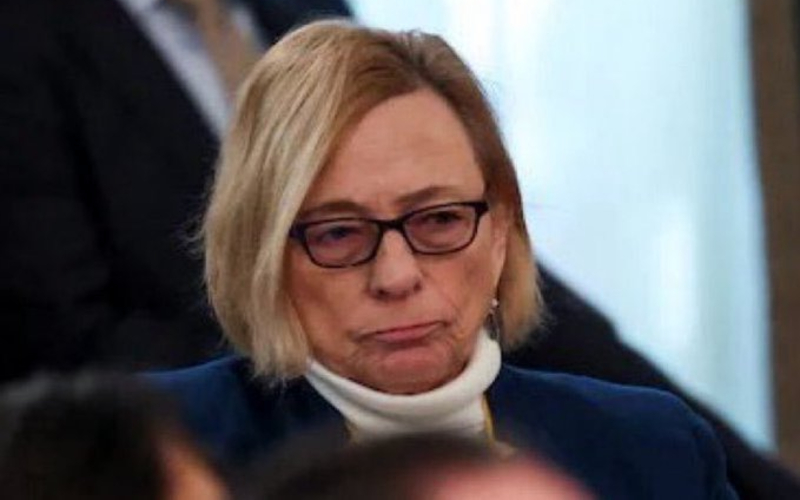
House Speaker Mike Johnson (R-Louisiana, shown right) stopped short of predicting a 20-seat gain but shares the president’s enthusiasm.
“We're going to get a new map in Louisiana. I think a number of the states in the South may get the same treatment because their maps are also drawn on an unconstitutional basis at this point,” he said on “Washington Watch” Monday.
Job jeopardy for Cleo Fields
Louisiana’s 6th District was drawn to connect as many majority black communities as possible. The result was a district, often-described as snake-like, that began in Shreveport in the northwest and worked its way some 200 miles to take in parts of Alexandria and Lafayette before ending in Baton Rouge in the southeast.

The Louisiana 6th is currently represented by Democrat Cleo Fields, 63, who represented the 4th District from 1993-1997 after a lengthy career in the state senate.
When citizens fully process the lengths to which Louisiana lawmakers worked to exclude white voters in this 6th District, organic change will occur in Republican-led states, Johnson told show host Tony Perkins.
“The more people recognize that, the greater the chances we get maps that accurately reflect the populations of those states. I think in the end of this, the Republican Party will gain a number of seats, and that would be helpful to the House,” he said.
After the Callais ruling on April 29, Louisiana Gov. Jeff Landry issued an executive order on April 30 suspending the May 16 primary and June 27 runoff for all six U.S. House races, citing an “election emergency” due to the state’s suddenly invalidated voting map.
The suspension applies only to congressional races. Other elections — such as races for U.S. Senate seats and state offices — will proceed as scheduled.
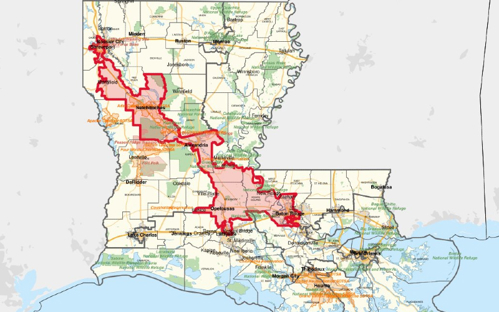 Louisiana’s new congressional map could be completed by the middle of the month with work to begin as soon as this week, Johnson said.
Attorney General Liz Murrill confirmed the Legislature has the authority to act swiftly and does not need to wait for federal court intervention.
The post-Callais flurry of activity could see Louisiana return to a “jungle” primary in which all candidates run in the same election and can win outright in the first round if they total 50% plus one vote. If not, the top two advance to a runoff even if they’re from the same party.
Lawmakers voted to replace the jungle primary in 2024; Louisiana is currently scheduled to transition to a closed-party primary for this fall’s elections.
“I expect that we may go back to the old system, as we used to do in Louisiana, where we have a jungle primary, as it's called, in November and then the runoff in December. That may be the only way to allow enough time for all this to settle out,” Johnson said.
Supremes got it right
Johnson praised the Supreme Court’s decision.
“You can't allow political issues to be the main driving factor in making sure that people are fairly represented in their states, and the Court has to look at this objectively. They have to evaluate these ideas on the basis of the Constitution. I think they did the right thing (3:50) here.”
An even bigger change to benefit Republicans is on the horizon, Johnson said.
“In 2030, after the population shifts out of the blue states are reflected, all those people moving to the red states, you're going to have many more seats,” he said.