



Democrat Mikie Sherrill vacated her Congressional seat when she won the New Jersey governor's race, creating the need for a special election.
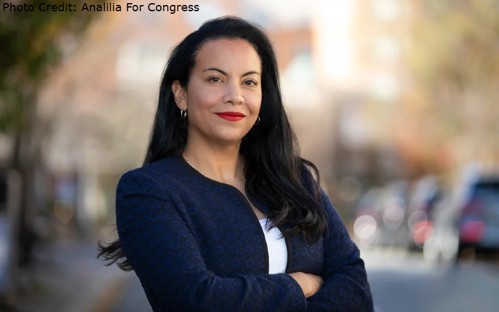 In the only debate in the special election, Republican Joe Hathaway tried to convince voters that Democrat Analilia Majía is antisemitic, noting she has claimed that Israel committed genocide in Gaza. Jewish voters make up a key part of the district's electorate.
However, according to Associated Press, Majía won the special election and will serve as a representative of New Jersey until January.
Along with a string of examples of antisemitism, she ran to abolish U.S. Immigration and Custom Enforcement (ICE) and to provide Medicare for All. She is also a former head of the Working Families Alliance who ran with the support of Sen. Bernie Sanders (D-Vermont) and Rep. Alexandria Ocasio-Cortez (D-New York).
Gary Bauer, chairman of the Campaign for Working Families, says she is far more radical than the now governor.

"They were willing to vote for the congressional incumbent several times, who's now the governor of New Jersey, and she was more of a mainstream liberal. This woman is a far-out leftist,” Bauer says, “but I think the lesson, the message, here is clear: if you win the Democrat primary, Democrat voters are going to vote for you."
Gone is the Democrat Party of his youth, he says.
"When the Democrats nominated people totally on the far left — like George McGovern, for example — the Republican Party would win landslide elections," Bauer states.
Today's Democrats, he says, are out there with what should be a losing agenda anywhere in the country.
"But of course, the country has changed. It's a lot different country than it was in the 60s, 70s, and 80s, to the worse as far as the demographics of the United States and the willingness of millions of people to vote for socialist Marxist candidates," Bauer says.