

In 2018, Oklahoma passed State Question 788, which legalized the use of medical marijuana. The Oklahoma Medical Marijuana Authority was soon established to oversee the program.
Now, it appears that the state regrets its decision.
Stitt, shown at right, was a guest on “Washington Watch,” discussing the topic after he called for the shutdown of the state’s medical marijuana industry during his State of the State address. He says that Oklahomans were sold a “bill of goods” in 2018 before he was governor.
“They thought they were passing medical marijuana. They thought they were passing something that was going to help someone with chronic pain, and that was the only thing that could help them,” informs Stitt. “But what actually happened is we have more dispensaries now than we have pharmacies.”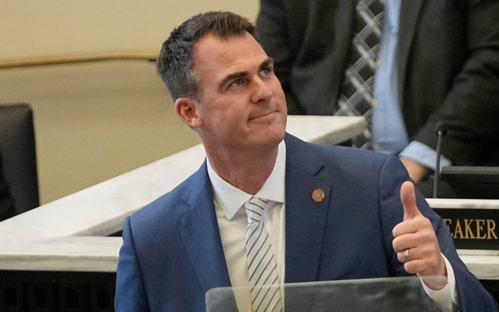
In this instance, the ease of getting a citizen-led initiative on the ballot became a problem, he told show host Tony Perkins.
“We've tried to make that a little more challenging and a little more representative around the state. But used to, you could just stand out in front of the state fair, and you could collect signatures. We had these groups from California that would come in, collect signatures, get enough signatures and then get it on a ballot to the people,” explains Stitt.
He says that Oklahomans, like most Americans, are very compassionate.
“When you see the 30-second commercial that says, ‘Hey, this is going to help this young person or this cancer patient. This is the only thing that helped them a from a pain management standpoint,’ then we're going to say, ‘Okay, that's great. We want that,’” Stitt said.
They assumed, he says, that medicine was going to be dispensed out of pharmacies. Instead, the industry is now out of control, and the state has become adversely effected.
“We grow 32 times more marijuana than actually is consumed legally. We know it's brought in cartel activity, Chinese influence, buying land. It is not what Oklahomans thought that they were signing up for, and so I'm just asking the legislature let's send that back to a vote of the people,” says Stitt.
Another harm, he mentions, is marijuana’s effect on young people, especially since it is considered a gateway drug.
“The stats are just very frightening: 73% of youth have increased use of marijuana now because they think it's a medicine, or it's okay or, it's not as harmful. And I just think that's a bad representation of our state,” states Stitt.
He says he is frightened at the number of kids taking different edibles because it is legalized.
“There's just a lot of problems with this industry. And until it's legalized nationally, I don't think we should have a checkerboard of jurisdictions from these different states. It just creates all kinds of black-market problems,” he says. “And you've got all these kinds of banking regulations against it.”
Critics point out that the legalization of marijuana in one state could hinder job creation as most jobs require drug testing.
 Stitt agrees.
“It is a really big, big problem when it's illegal federally. Then you have these medical marijuana exceptions where anybody with a hangnail can get a medical card now. How is an employer supposed to deal with that?” questions Stitt. “They're trying to keep their employees safe.”
The National Transportation Safety Board reported in 2023 that cannabis is the second-most common drug for impaired driving accidents.
There have been individual incidents where marijuana was involved in crashes in Oklahoma.
For example, investigators last fall said a semi-truck driver involved in a multi-vehicle crash on Interstate 35 tested positive for marijuana, and manslaughter charges followed.
“But we know it's inhibiting their ability to drive safely. So, we had to pass a law last year to make it crystal clear that we don't … we will not allow you to smoke or be high in a car, even if it's for “medical use,” states Stitt.
New law helps
Senate Bill 786 took effect in November after passing the Oklahoma legislature last May.
It prohibits the consumption of “marijuana or inhaling second-hand marijuana smoke while operating a motor vehicle on public highways, streets, or alleys.”
It also made it illegal to have an open marijuana container in the passenger area of a motor vehicle.
The state is trying to bring clarity through its laws, Stitt said.
“From a workforce standpoint, a lot of times they have to do business in other states. So, they have regulations, they have to test their employees, and we run into a lot of complications,” says Stitt.
Ultimately, he believes that Oklahoma citizens will be able to vote on restricting or eliminating access to medical marijuana.
“We've had some great conversations with the House, the Senate. They know it's a problem. Oklahomans all over are calling our offices saying it's a problem, and so, I think we'll get something back to the people,” concludes Stitt.