


But with mid-term elections now less than a year away the GOP still faces major challenges to retain control of Congress, Ken Blackwell, Family Research Council’s advisor for election integrity, said on Washington Watch Thursday.
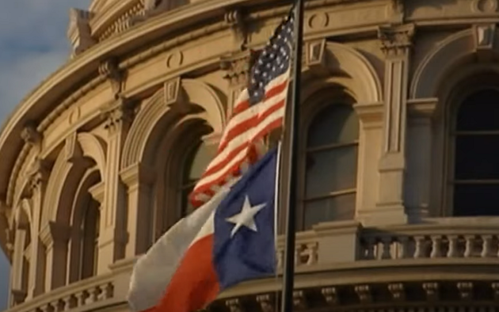
The Supremes will weigh in on the Texas plan again. For now, the Court issued a stay, allowing Texas to use its new election map for 2026 while it further reviews the case. The new map is expected to deliver five new Republican House seats.

California is expected to negate Texas gains with its own redistricting effort – Proposition 50 which its voters passed in November – with five more Democrat seats from that state.
If the same Supreme Court logic is applied for legal challenges faced by Prop 50, California Democrats will soon cheer again, The Sacramento Bee writes.
A federal court will hear oral arguments over California’s new congressional map on Dec. 15.
Republicans currently hold 219 House seats with 212 for Democrats. There are four vacancies.
In the Senate, Republicans have 53 seats, Democrats 45. There are two Independents, both of whom caucus with Democrats.
Seven to nine states “have been flirting” with redrawing their Congressional district, Blackwell told show host Tony Perkins.
“That means that the burden is going to be on Speaker (Mike) Johnson and the Republicans to hold the line. When it's all said and done, I think the courts will probably balance it out, where there might be an uptick of a two- or three-seat advantage in the redrawn lines. But the fact of the matter is that the Republicans are still swimming upstream.”
Historically, midterms tend to be a referendum on the sitting president, and the president’s party tends to lose seats: since World War II, the average seat change in midterms has been a loss of about 28 seats in the House and 4 in the Senate for the president’s party.
Only in three midterms since the 1930s did the president’s party manage to gain House seats: 1934, 1998, and 2002.
 The Voting Rights Act of 1965 allowed states to create a majority-minority district in order to protect the rights of minority voters. African-American voters were at the forefront of thoughts then.
The Supreme Court may be about to make a change.
“The reality is that with the mobility and the upward mobility economically of Blacks, there is no way that I think the Supreme Court is going to lock us into a 1965 model, which would then mean that a lot of the redistricting will, in 2026 and perhaps really in 2028, give us a different playing field,” Blackwell said.
In addition to California and Texas, Missouri, North Carolina, Ohio and Utah have already adopted new voting maps.
Indiana, Virginia, Florida, Nebraska, Kansas, Illinois and Maryland are at least considering it.
Blackwell thinks Republicans are in position to buck the mid-term voting trends for the president’s party – and the driver will be the economy.
“I think that the president has brought us out of such a deep economic hole that in the final analysis in 2026, you're going to see a lean towards the Republicans as being the uplift from economic malaise that the Biden administration put us in,” he said.