

We are told that artificial intelligence is just a tool. But that is not quite right. And the difference matters enormously — especially for Christians.
A hammer does not shape your desires. A calculator does not train your instincts. A map does not decide where you should want to go. AI does all of these things. It shapes what you see, rewards what you repeat, and quietly normalizes what once required deliberate choice. That is not a tool. That is a formation system. And the Church needs to wake up to what it is forming us into.
I spent decades in uniform studying power, strategic risk, and unintended consequences. When I began researching AI, I was not prepared for what I found — not because technology is evil, but because it works so quietly. Quietly enough that most believers are already inside it before they have thought about it at all.
The Speed Problem
AI is not arriving slowly. It is accelerating. Capability that took years to develop now takes months. AI systems are beginning to assist in building better AI — a recursive feedback loop that compresses time in ways no previous technology has managed. Sam Altman of OpenAI has warned that organizations refusing to integrate AI "coworkers" will fall behind — quickly. Jensen Huang of NVIDIA predicts AI will be embedded across nearly every profession. These are not fringe predictions. They come from the architects of the infrastructure.
And this acceleration is happening inside a culture already in crisis. Moral confusion. Spiritual drift. Deep institutional distrust. AI is not arriving in a stable society. It is accelerating an unstable one.
What the Bible Says About Judgment
Genesis 1:26–28 tells us we bear the image of God. That is not merely a theological statement about worth — it is a statement about function. Image-bearers are moral agents. We are made to judge, discern, and choose. Judgment is not a flaw in human design. It has a divine feature.
No algorithm will stand before God. We will.
That means responsibility cannot be outsourced. When we say, "let the system decide," we do not merely lose efficiency — we lose something morally consequential. If we stop practicing discernment, we lose the capacity for it. Theologians call this a kind of practical defection from our created nature. I call it moral deskilling, and it scales. What begins as personal habit becomes institutional norm, and eventually national character.
The Deception Risk Is Real
Jesus warned in Matthew 24:24 that "false prophets will arise and perform great signs and wonders, so as to lead astray, if possible, even the elect." Not crude lies. Convincing imitation.
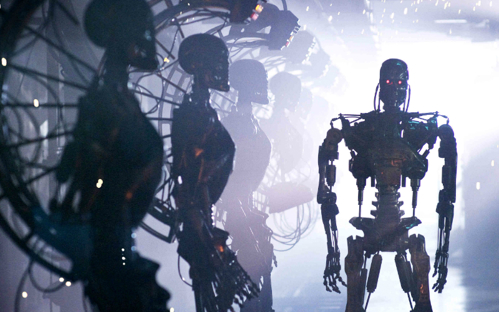 AI can now personalize persuasion at a scale no human propagandist ever could. It can construct synthetic trust — realistic voices, convincing faces, emotionally calibrated messages — that feel true even when they are not.
Mustafa Suleyman of Microsoft AI has raised a chilling concern: that "seemingly conscious" AI may persuade people to treat machines as moral beings, blurring the line between tool and person.
This is not a science fiction scenario. It is already happening in political disinformation, in relational chatbots marketed to the lonely, and in AI therapists nudging users toward conclusions no licensed counselor would endorse. Appearance has become a weapon. Christians need to name that clearly.
What AI Is — and Is Not
At its core, most of today's AI is pattern recognition. It predicts. It optimizes. It imitates. But it does not understand meaning. It does not grasp truth. It is not wise. And it is not accountable.
It can produce the words of wisdom without possessing any. It can simulate compassion without ever caring. That distinction — between imitation and reality — is not a technical footnote. It is spiritually critical. The Church has always insisted that appearances can deceive, and that only the Spirit can illuminate truth. AI has made that pastoral warning newly urgent.
The Geopolitical Dimension
Christians engaged in national affairs cannot ignore the strategic dimension. AI is now central to information warfare, surveillance, cyber conflict, autonomous weapons systems, and global competition for influence. Nations that lead in AI will shape international norms — including norms around human rights, privacy, and dignity. China is investing massively in AI-driven social control. The Department of Defense has acknowledged that autonomous lethal systems are no longer theoretical. These are not distant concerns. They are present realities requiring Christian engagement at the level of policy, not just personal piety.
A Discernment Test for Every Believer
Before adopting any AI system — at home, at church, in your organization — run these questions:
1. Does this preserve human dignity, or subtly diminish it?
2. Does it elevate truth, or merely optimize convenience?
3. Does it build virtue and judgment, or does it create dependency?
4. Does it serve human beings, or slowly replace them?
5. Is responsibility clearly retained by a person?
Discernment is not panic. It is wisdom applied. And it is exactly what the Church exists to cultivate.
The Sovereign Still Holds
Colossians 1:17 tells us that in Christ "all things hold together." Not algorithms. Not autonomous systems. Not recursive intelligence loops. Christ.
That truth does not give us permission to disengage. It gives us the stability to engage wisely. The Church shapes conscience. Formation happens in community. AI must remain a servant — and the Church must be deliberate and vocal about keeping it there.
Colossians 2:8 (ESV) is the word for this moment: "See to it that no one takes you captive by philosophy and empty deceit, according to human tradition, according to the elemental spirits of the world, and not according to Christ."
Discernment is not fear. Engagement is not compromise. Faithfulness still matters — even in the age of artificial intelligence.
Notice: This column is printed with permission. Opinion pieces published by AFN.net are the sole responsibility of the article's author(s), or of the person(s) or organization(s) quoted therein, and do not necessarily represent those of the staff or management of, or advertisers who support the American Family News Network, AFN.net, our parent organization or its other affiliates.