




For the second time in the Trump presidency, the Right is debating the concept of the common good and how that concept fits within the American political tradition.
During Donald Trump's first term, the "common good" debate raged because the unorthodox president's nationalist instincts and policy prescriptions on issues such as trade and immigration clashed with the more globalist preferences of the Republican Party establishment. The debate is now raging once again, it seems, because JD Vance, the odds-on favorite to become the 2028 GOP presidential nominee, is seen as sympathetic to what might be called "common good conservatism" or "post-liberalism."
And that impression of Vance is correct. I would know, because I have long traveled in many of these same circles. I weighed in heavily during these debates the first time around, even proposing a novel theory of constitutional interpretation called "common good originalism."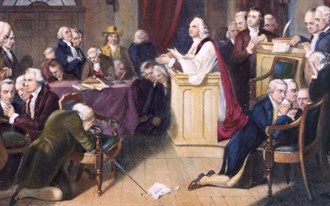
But this second round of the "common good" debate has been less than edifying. On the anti-"common good" side, there have been way too many intellectual arsonists razing fields of straw men of their own making. And on the pro-"common good" side, there has been way too much inane trolling and stupid, low-IQ slop.
It is time to set the record straight about the common good. And the most obvious starting place is this: The common good is emphatically part of the American political tradition.
The Constitution's Framers explicitly identified the common good as the very reason for the charter's existence: The Preamble simply refers to the identical concepts of a "more perfect Union" and the "general Welfare." In The Federalist No. 57, James Madison wrote that the "aim of every political constitution" should be the cultivation and elevation of "men who possess most wisdom to discern, and most virtue to pursue, the common good of the society."
The common good refers to a collectively held good that is attainable only when the political entity's citizens flourish in harmony with one another. It is a collective good that is greater than the sum of its parts. In politics, it is an aspirational goal — a statesman's lodestar. Plato and Aristotle spoke of the common good. So too, for that matter, does the Bible. As God said to the Israelites assembled at Mount Sinai, "You shall be to Me a kingdom of priests and a holy nation."
Unfortunately, the current idiotic discourse on the common good is doing a disservice to an important debate.
Many of the loudest conservative critics of the common good see in its invocation a rejection of individual liberty. But that's a false choice. The Framers cherished liberty and saw it as one of the most important components of the common good. It's just that there are other components too, like order and virtue. Some of the common good critics imagine the common good-ers to be closet monarchists or statists. But that too is rubbish: Madison, who more than anyone else was the father of our non-monarchist and non-statist Constitution, described the common good as the document's very "aim."
On the other hand, some of the common good's purported champions have turned out to be their very worst enemies. On X, some ostensible common good-ers have clamored, especially in light of the recent migrant invasion of Spanish exclave Ceuta, for "Franco Friday." That would be a reference to Francisco Franco, the 20th-century Spanish dictator. No American should be praising fascism, or any individual fascist, in the name of the "common good" — period. Nor can the "common good" justify whitewashing antisemitism or any other sort of overt discrimination.
We've got to talk about this
The most frustrating part of this online slop-fest is that there is a real debate to be had here.
In trade policy, America has in recent decades veered too far on the side of globalism and consumerism, at the expense of production and supply chain resilience. In immigration policy, America has in recent decades veered too far on the side of openness, at the expense of civic solidarity and cultural cohesion. And in the culture war, America has in recent decades veered too far on the side of amoral, "live and let live"— style permissiveness — from marijuana to surrogacy to transgenderism, and beyond.
How to balance individual liberty and dignity with the common good is one of the oldest questions in politics. But here's the thing: America's Founding Fathers had it right. They nailed it. Conservatives should recognize that, instead of rewriting the Founding or stanning for dictators.
But in order to do that, we need a real debate first.
Notice: This column is printed with permission. Opinion pieces published by AFN.net are the sole responsibility of the article's author(s), or of the person(s) or organization(s) quoted therein, and do not necessarily represent those of the staff or management of, or advertisers who support the American Family News Network, AFN.net, our parent organization or its other affiliates.