





Donald Trump’s new golden statue has ignited exactly the kind of internet outrage one would expect in modern American politics. Critics immediately compared it to the golden calf in Exodus, accusing Trump supporters of literal idolatry and cult-like devotion.
Pastor Mark Burns pushed back, arguing the statue is not “golden calf worship,” but rather a symbol of resilience, patriotism and political support. In many ways, he is correct. Most conservatives are not bowing before a statue of Donald Trump as though he were a deity.
But the controversy still raises an important biblical question Christians should not dismiss too quickly: What does Scripture say about monuments, statues and the glorification of men?
The answer is more nuanced and important for Christians to consider.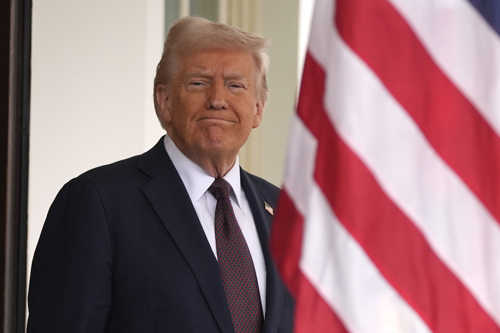
The golden calf account in Exodus 32 was not merely about artistic expression or political enthusiasm. Israel fashioned an idol and directly attributed divine power and deliverance to it. The people literally exchanged worship of the Lord for a created image. That is not what is happening with Trump supporters today, and Christians should avoid careless accusations that cheapen the seriousness of biblical idolatry.
But the Bible’s warnings do not stop with pagan worship. Throughout the Old and New Testaments, God repeatedly warns against pride, self-glorification, and the elevation of earthly rulers beyond their proper place.
Some things stay the same
One of the clearest examples comes from King Nebuchadnezzar in Daniel 3. The Babylonian king erected a massive golden image and commanded the people to bow before it. The issue was not merely the existence of a statue. Ancient civilizations were filled with monuments. The deeper issue was what the image represented: political power demanding reverence and ultimate allegiance.
Sound familiar? Human nature has not changed much since Babylon.
Rulers throughout history have built monuments to themselves because power craves permanence. Nations erect statues, carve faces into mountains and name buildings after leaders in an effort to immortalize influence. The danger is not always outright worship. Sometimes the danger is subtler: cultivating awe, devotion and emotional dependence around human authority.
Christians should remember that no politician is a messiah. No president is a savior. No earthly ruler deserves ultimate allegiance.
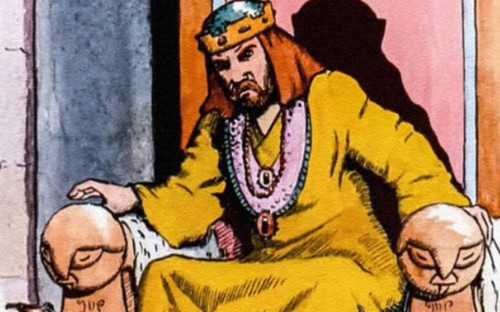
The story of King Saul provides another warning. In 1 Samuel 15, after a military victory, Saul erected a monument to himself. The chapter is striking because Saul’s monument appears alongside his growing disobedience and pride. The prophet Samuel later rebukes him sharply because Saul had become far more concerned with preserving his own image than honoring God.
Saul (Illustration by FreeBibleImages.org) knew the Lord yet was filled with pride. That temptation is hardly unique to ancient Israel.
 Politics naturally gravitates toward personality. Modern campaigns are built around branding, celebrity, emotional loyalty and personal charisma. It is easy for us to slowly transfer hope, security and identity from enduring principles to individual personalities. Christians are not immune to this temptation, especially when the leader supports policies we favor.
This is where the current debate deserves more thought than either side is giving it.
No, conservatives displaying a statue of Trump are not necessarily engaging in literal idol worship. But Christians should still be willing to ask whether modern political culture increasingly encourages a kind of unhealthy reverence for personalities rather than gratitude directed ultimately toward God’s providence.
Are we taking honor and glory from the Lord and applying it instead toward earthly rulers?
The Bible offers a striking contrast in the memorials Israel was commanded to build.
When Israel crossed the Jordan River in Joshua 4, God instructed the people to stack stones as a memorial. Why? Not to celebrate Joshua’s leadership. Not to glorify Israel’s military strength. Not to remember Moses. The memorial existed so future generations would remember what the Lord had done.
Over and over again in Scripture, memorials point upward, not inward.
Altars and monuments in the Old Testament were designed to testify to God’s faithfulness, God’s covenant and God’s deliverance. Even the prophet Samuel erected a stone called Ebenezer, declaring, “Thus far the LORD has helped us.” The focus was not on human greatness, but divine mercy.
That distinction matters enormously.
There is nothing inherently sinful about honoring leaders or appreciating courageous political action. Christians should be grateful for policies that protect life, preserve religious liberty or restrain government overreach. Gratitude for leadership is not idolatry.
But Scripture consistently warns against allowing admiration to evolve into exaltation.
America increasingly treats politics as a religion and a form of temporal salvation. Both parties often speak as though the next election determines the ultimate fate of civilization itself. Citizens place impossible expectations on politicians and then swing between euphoria and despair depending on who occupies office. In that environment, larger-than-life political imagery can feed a deeper cultural problem already consuming the nation: the tendency to look to man for deliverance instead of God.
Psalm 146 offers a timely reminder: “Put not your trust in princes, in a son of man, in whom there is no salvation.”
A Left and Right thing
That verse does not command Christians to withdraw from politics. It does not forbid supporting strong leaders or celebrating political victories. But it does establish an important boundary. Political leaders are temporary. Nations rise and fall. Human power fades. Only God deserves ultimate trust and glory and honor forever.
The irony is that many Christians rightly criticize the secular Left for elevating celebrities, activists and politicians into near-messianic figures while failing to recognize how easily the same temptation can emerge on the Right. Personality cults are not confined to one ideology. They are products of fallen human nature.
The controversy over Trump’s statue should prompt reflection. Christians do not need to pretend it is the golden calf of Exodus. But neither should they dismiss all concern about the symbolism of elevating political figures through grand monuments and imagery centered on personal greatness.
Biblical memorials were intended to decrease man and magnify God. That remains a wise standard for Christians today — in politics as much as anywhere else.
This column first appeared in The Christian Post.
Notice: This column is printed with permission. Opinion pieces published by AFN.net are the sole responsibility of the article's author(s), or of the person(s) or organization(s) quoted therein, and do not necessarily represent those of the staff or management of, or advertisers who support the American Family News Network, AFN.net, our parent organization or its other affiliates.