


In the Era of Trump, the left-wing protest movement has misled itself into a cul-de-sac of frivolity, trading away any real object or persuasiveness for plenty of staying power. On March 28, an estimated eight million protestors gathered for some 3,000 demonstrations in the third round of the coordinated, anti-Trump protests branded as “No Kings.” But what are these protests? And why are they happening? There seems to be no clear answer to either question.
The character of the “No Kings” rallies varies wildly by location. “We love America, and we are the real patriots, here,” 73-year-old Robin Gillis told the Detroit Free Press at a “No Kings” gathering in West Bloomfield, Mich. In one hand, she held a sign reading, “We the People have had enough!” In the other, she held her dog’s leash. In downtown Los Angeles, demonstrators graffitied federal buildings with anti-ICE slogans, then assaulted federal officers when the assembly was declared unlawful.
Such contradictory behaviors and tones underscore the contradiction at the root of the “No Kings” movement. Is it a non-violent brand of protest, where aging progressives can assemble to harmlessly work out their frustration at President Trump? Or is it a vanguard of revolutionary social change for black-clad anarchists looking to overthrow the system? Currently, like many left-wing causes du jour, the movement’s tent is broad enough to encompass both elements.
On March 28, “No Kings” protestors even demonstrated abroad, in European nations like Italy, France, Germany, and Spain. Ironically, seven European nations, including Spain, still have kings (two others are ruled by princes and one by a grand duke). These European protests provide further reason to conclude that the “No Kings” movement is driven less by principled opposition to monarchy as an idea than by personal opposition to Donald Trump as an ineradicable foil to leftist folly.
According to the grandiloquent self-history on the “No Kings” website, the protest movement began as a plan to prevent President Trump from seizing authoritarian power in conjunction with his June 14, 2025 military parade (June 14 happens to be both President Trump’s birthday and the U.S. Army’s birthday). In their retelling, “President Trump’s birthday parade was drowned out by protests in every state and across the globe. His attempt to turn June 14 into a coronation collapsed, and the story became the strength of a movement rising against his authoritarian power grabs.”
These implausible claims ask readers to believe that coordinated but localized protests foiled an attempted coup by “drowning it out” on social media. This proposition is based on other unreliable propositions: 1) that Trump has actual plans to install himself as a dictator through a military coup; 2) that a military long steeped in republican principles would go along with such a plan; and 3) that dispersed, unarmed protestors would cause someone about to execute a military coup to abandon those plans in terror.
Indeed, that “No Kings” organizers even find this narrative plausible in the first place suggests that they have a distorted sense of the importance of street activism to America’s system of government — but more on that below.
In any event, the protest movement — which officially eschews violence — went on to describe itself as “a nationwide uprising” and “a sustained national resistance to tyranny.” At least this guerrilla language should be interpreted metaphorically, right?
The organization lists its reasons to believe that “President Trump has doubled down” on his ambition to reject the tradition of George Washington and make himself the first American monarch. Trump is “Gutting health care, environmental protections, and education,” they hyperventilate, and “Ignoring mass shootings.” How these boilerplate left-wing policy concerns have any relevance to a monarchy is left unexplained. Trump is “targeting immigrant families,” “Driving up the cost of living,” and conducting “missile strikes abroad,” they warn. These voting issues are the main challenges Republicans will face in the midterm elections (with “elections” being the key word), not existential threats to a republican (small-r) form of government.
The only items related to America’s form of government to make the list are fears that Trump is “Rigging maps to silence voters” and “Threatening to overtake elections,” allusions to Trump’s cajoling states to perform mid-decade redistricting and his (thus-far unsuccessful) effort to pass a voter ID law through Congress. In both instances, the national and state legislatures retain control of their legislative power — and not always in Trump’s favor. On the whole, this is very poor evidence that Trump plans to abolish elections entirely and assert a legislative power of his own.
So, what is the message of the “No Kings” movement? While attendees have varying ideas and dispositions, a sticker placed illegally at the Los Angeles demonstration captures the thrust: “The Trump Fascist Regime must go now!!!”
Whatever one’s opinion of Trump the man, or political preferences, there should be two problems with this statement. The first is the word “now.” Constitutionally speaking, the appropriate time to remove an incumbent president would be in the next election — scheduled for November 2028, more than two years in the future. Or, if “regime” is interpreted to mean not only the administrative branch but the Trump-aligned majority in Congress, the appropriate time would be in the election of November 2026. The only way to remove Trump “now” is through an unconstitutional, undemocratic coup of the sort the “No Kings” movement officially abhors.
The second problem is the word “fascist.” Leftists love to throw this term around to describe their opponents, but they never pause to define it. In fact, there’s a good chance that most readers will have heard the word many times and still not know what it means.
Fascism refers to the political party of Italian strongman Benito Mussolini, often seen as a sort of “little brother” to Adolph Hitler for his similar method of seizing power and their alliance during World War II. (Thus, the point of labelling people as “fascist” seems to be creating the negative associations of Nazism without actually calling someone a Nazi, although many leftists do so anyway.)
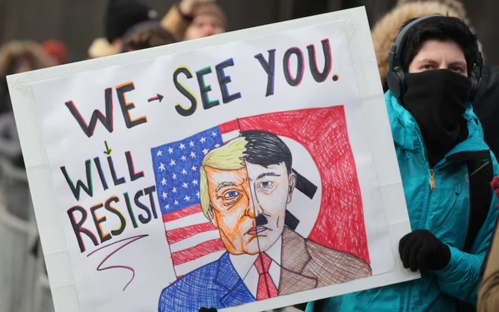 The fascists organized unofficial, black-shirted street squads that committed systematic violence to fulfill their political aims. After destabilizing the country, these squads then violently suppressed the party’s opponents, including communists, Catholics, and liberals. There is no corollary in America today, but the closest analogue is the cells of black-clad agitators who attack government property, cause mayhem, and call themselves, ironically, “anti-fascist.”
American leftists call Trump a fascist because the fascists promoted a strong, populist nationalism. Yet, in contrast to America’s long history of self-government, Italy did not fully unite until 1871, which meant the constitutional monarchy was younger than living memory in the 1920s. To promote his vision for Italian national greatness, Mussolini led Italy on a bloody quest for imperial conquest in Ethiopia.
From a policy perspective, fascism is most similar to socialism. Instead of allowing the free market to allocate resources naturally, and instead of allowing capitalists to invest their wealth to grow the whole economy, fascist policies constrained the economy, breaking both businessmen and labor unions and making fascism an inescapable force in daily life. Moreover, fascism’s revolutionary attitude led it to reject the Christian church — another similarity with communism and today’s American Left.
The combination of these two sentiments — nationalism and socialism — leads many to draw comparisons between Mussolini’s Italy and Nazi (National Socialist) Germany. But this two-part identity means that the label “fascism” cannot be justly applied to any form of nationalism. While Trump (and many other leaders in modern history) bears some similarities to fascism in that he is a nationalist, leftists forget that they too bear some similarities to fascism in that they are socialists.
Always incompetent, fascism largely died out in World War II, and any parallels that can be drawn are incomplete and therefore inaccurate. In most cases, it is best to leave the label behind in the past as a signpost warning historical sightseers against the quest to build a godless state. Alas, the Left believes their abuse of the label is too politically powerful a weapon to lay down in the past.
Yet the Left is where most participants in fascist-style political violence lodge today. After several “No Kings” protests, unlawful demonstrations (so named because they committed unlawful acts) broke out in several cities. In Los Angeles, a crowd of more than 1,000 surrounded a federal building, assaulted ICE officers, slashed tires, and graffitied buildings. Some agitators threw bottles, rocks, and cement blocks, injuring three federal officers, including one who was struck in the head and rushed to the hospital. When law enforcement officers finally got the situation under control, they arrested 75 individuals, mostly for refusing a lawful order to disperse.
In Portland, masked, helmeted agitators fought with police and hurled objects at them. In Denver, fragments from a crowd of 10,000 attempted to block a highway entrance ramp, resulting in nine arrests. In Dallas, “anti-Trump demonstrators clashed with equally incendiary right-wing counterprotesters,” in National Review’s description.
What is the character of the “No Kings” protests? Is it anti-Trumpers peacefully voicing the opposition with no clear purpose? Is it cover for a violent element committed to sowing generically destabilizing chaos? Is it misplaced accusations of fascism from those open to the same charge? No one can answer these questions definitively. One thing, however, is certain. In countries ruled by actual tyrants, such widespread protests against the regime are not permitted. If the movement has proven anything, it is that neither Trump nor any other American president is a “king.”
Notice: This column is printed with permission. Opinion pieces published by AFN.net are the sole responsibility of the article's author(s), or of the person(s) or organization(s) quoted therein, and do not necessarily represent those of the staff or management of, or advertisers who support the American Family News Network, AFN.net, our parent organization or its other affiliates.