

Is there any international organization that has done more to bolster the Cuban socialist tyranny than the United Nations?
I know it's politically incorrect to say that it's unwise to stop speaking there about the true situation on the island. After all, there have also been condemnations from the U.N. platform, and so on and so forth. The reasons are as many as the list of fools who annually advocate for lifting sanctions against the Cuban totalitarian state. I get it.
But what goes through your mind when you read that Cuba is given seats on the U.N.'s Commissions on Social Development and on Crime Prevention and Criminal Justice? What commissions! The Commission on Social Development is the most absurd. Socialism promised the country a bright future and has left it with nothing but blackouts every other day.
Cuba's inclusion among the countries that will oversee crime prevention and criminal justice is an insult to families like those of young Andy García Lorenzo or Nadir and Jorge Martín, who have not found justice for their children.
The U.N. Human Development Index, which sounds pompous and desirable, serves as a propaganda opportunity for the Castro regime. While it takes into account a country's per capita income, years of schooling, and life expectancy, in Cuba's case, the latter two factors artificially inflate its position in the world ranking.
The regime controls and finances the mandatory state system of indoctrination — not schooling — for Cubans from preschool age through doctoral studies. On the other hand, life expectancy, as related to health care services, must have declined in recent years, a time when there are no plaster casts for broken bones, no aspirin in pharmacies, and Cubans are harking back to pre-Columbian times, resorting to mixtures of herbs, roots, and infusions to relieve pain.
The United Nations system not only symbolically validates the Cuban socialist tyranny but also lines its pockets with money and trains its cadres to secure these vast resources. Of course, all in the name of reducing inequality and other Marxist platitudes.
The United Nations Development Programme (UNDP) organized a Conference on Financing for Development this week in Havana, bringing together international institutions, cooperation actors, and government agencies to discuss innovative sources and initiatives for financing development. But whose development? The development of the starving Cuban population, who are prohibited from freely producing, selling, or exporting?
The Castro regime, all smiles, thanks the globalist elite for the lifeline. New York bureaucrats are showing the bureaucrats at the Palace of the Revolution the challenges and opportunities of accessing international financing in areas such as “energy transition, pharmaceutical production, and environmental conservation.”
Unelected U.N. officials are handing the keys to regional and subregional development banks and explaining the intricacies of the operation and creation of national development banks and other innovative mechanisms to the unelected officials of the Cuban regime.
The UNDP wants to finance, to throw shovelfuls of money at the longest-running dictatorship in the Hemisphere, to accelerate the 2030 Agenda, its officials say. Not so that there will be freedom in Cuba, nor respect for the Universal Declaration of Human Rights or natural law. Rushing to their appointment in their modern Chinese cars, through the crumbling streets of what was once Havana, come the officials from the Ministries of Economy and Planning, Foreign Trade and Foreign Investment, and Foreign Affairs, the Central Bank of Cuba, the UNDP, and the Central American Bank for Economic Integration.
What real and effective oversight can be exercised over how a totalitarian system manages funds?
Back in 2022, the regime was invited to the Executive Board of the United Nations Children's Fund, just months after arresting and trying dozens of minors who participated in the July 11-12, 2021 (11J) protests in various parts of the country.
In October 2023, having broken the record for the highest number of political prisoners per capita in the Western Hemisphere, Cuba was one of the 47 states elected to the U.N. Human Rights Council. What was most disturbing was not that, but rather that it was the sixth time the supranational body had honored Cuba for massacring defenseless civilians at sea, demolishing and harassing religious sites, and imprisoning reporters and artists.
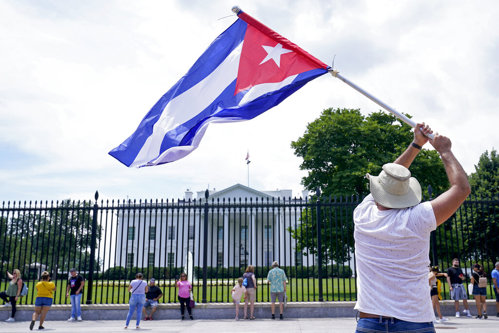 Following the secret, direct, and individual vote of 146 members of the General Assembly, Cuba received the highest number of votes of any country in the region. The Ministry of Foreign Affairs interpreted this as a sign of “the prestige the country has achieved in the work” of that body. In reality, there are two issues.
There emerged an alignment within the U.N with Cuba's equalizing ideals (which only equalized poverty), and Fidel Castro's early move to establish embassies. This alignment sought to exert influence through in every possible country, with only two exceptions: Israel, so as not to upset jihadists and Arab socialists, and South Korea, so as not to disturb the red dynasty in Pyongyang.
In 2019, a few months before the Castro regime placed me on the Regulated list for two and a half years, I was part of a small delegation of Cubans who advocated for freedom of conscience at the Human Rights Council in Geneva, Switzerland. You can find all sorts of people there.
We talked for hours in the building's spacious and brightly lit cafeteria-lounge with ambassadors from Poland, Hungary, and the Czech Republic, who were very attentive and shared similar stories stemming from the Marxist past of those Central European nations. The Canadian official, who didn't seem particularly concerned that there were good people imprisoned in Cuba, excused himself to leave the chair opposite us. The South Korean diplomat took out a pen and notebook, taking notes while alternating his gaze between those speaking and the paper. "I'm very interested in you sharing what's happening firsthand," he said in perfect English.
The council headquarters was filled with Chinese propaganda about respect for art in that country, while an exhibition was being advertised with giant posters and promotions. The Chinese Communist Party had money to burn and knew where to spend it.
The U.N., needless to say, is not the only place where left-leaning activists act as political groupies for the Havana regime.
In 2023, the German socialist Udo Bullmann, president of the European Parliament's Subcommittee on Human Rights, vetoed a global resolution that condemned, for example, the use of torture and ill-treatment by Cuban authorities. This wasn't just any MEP, but the man who chairs the Subcommittee on Human Rights of the highest levels of European politics; this wasn't a contentious issue, but a clear moral compass for European values.
Having said all this, one thing is clear: the biggest problem isn't even the existence of international forums for dialogue, but the basis and foundation of that dialogue. Not all ideas, with their respective ideologies, lead to the flourishing of civilization.
Some are better than others. To pretend that a majority of socialists will magically side with those oppressed by a tyranny like Cuba's would be to ignore the historical pats on the back that the Soviet Union, China, Cuba, Venezuela, Nicaragua, the 21st-century socialists, and other similar models have received from these cherished multilateral institutions.
It would be a sudden and unprecedented paradigm shift if the U.N. administration were to condemn Cuban Marxists more than it would offer them. Something that, in mathematical terms, René Thom would describe as a quantitative expansion, which takes the form of a sudden and unexpected event. That is to say, something experienced more as a catastrophe than as continuity. Oh! The beautiful political catastrophe of the improbable.
This article originally appeared here.
Notice: This column is printed with permission. Opinion pieces published by AFN.net are the sole responsibility of the article's author(s), or of the person(s) or organization(s) quoted therein, and do not necessarily represent those of the staff or management of, or advertisers who support the American Family News Network, AFN.net, our parent organization or its other affiliates.