



American Family News spoke to Lt. Col. Ryan Sweazey (USAF-Ret.), the founder of Walk the Talk Foundation, a group that advocates for and protects whistleblowers. The former F-16 fighter pilot once served as Inspector General (IG) in the Air Force and points out that, in 2022, the California National Guard's IG concluded an extensive investigation into Col. Lisa Nemeth, who was then the commander of the 146th Airlift Wing.
This investigation involved over three dozen confidential interviews and a thorough examination of records, leading to the determination that Nemeth had engaged in conduct unbecoming of an officer, with four allegations substantiated against her, according to the Los Angeles Times investigation. Their report also indicated that the findings jeopardized Nemeth’s anticipated promotion to general.
However, in a surprising turn of events, the Pentagon intervened. The Air Force Inspector General's office in Washington, without conducting its own investigation, overturned all four substantiated findings against Nemeth. Internal records obtained by the LA Times reveal that Inspector General Stephen Davis stated in a memo that the review “did not identify actions, decisions, or omissions that seriously compromised Col. Nemeth's character or standing as an officer.”
Notably, as Maj. Gen. Matthew Beevers wrote in a “scathing memo” to Air Force Chief of Staff Gen. David W. Allvin, no new evidence was presented to support this reversal. California Guard officials described such an unsolicited override as a rare occurrence.
In stark contrast, as revealed by The Gateway Pundit, Col. Leslie Zyzda-Martin's (shown above) situation reveals a different narrative. In November 2021, she was removed from command at Wisconsin's Volk Field Air National Guard Base by then Brig. Gen. David May, who cited a “loss of confidence in her ability to command.”
Lack of recourse for Colonel Zyzda-Martin
She was not given an opportunity to respond to the allegations or evidence, and her removal came after multiple investigations that found no substantiation for the complaints against her. Despite being cleared by investigators, she has struggled to obtain clarity on her dismissal, as the categorization of her removal circumvents formal review processes. Her complaints to the Secretary of the Air Force, Under Secretary of the Air Force, and Secretary of the Air Force IG have yielded no results, and requests for further intervention have been met with the assertion that the “Air Force has no jurisdiction over Guard matters.”
 This claim raises questions, as the case of Nemeth illustrates that the Air Force Inspector General does indeed possess the authority to intervene in state Guard personnel decisions. “The inconsistency is glaring,” Sweazey observes. “An officer with four substantiated allegations against her received a rare intervention that cleared her record, while another officer, with no substantiated claims, remains without support.”
“This disparity reflects not just bureaucratic inconsistency but a potential failure of the Inspector General system to protect officers from arbitrary command decisions,” he argues. “The situation invites scrutiny into the criteria that dictate when the Air Force chooses to intervene.”
Zyzda-Martin continues to seek redress, deserving of the same thorough review afforded to Nemeth, and without that, the Air Force IG's office appears to be favoring certain outcomes over equitable enforcement of authority.
Behind the scenes
The pressure on Nemeth's case did not begin with Secretary of the Air Force, Office of the Inspector General (SAF/IG) review; it began months earlier, and in an informal manner. In June 2022, then-Lt. Gen. Michael Loh, director of the Air National Guard, called Maj. Gen. David Baldwin, California's former adjutant general, and left a voicemail asking him to throw out the substantiated findings and start the investigation over with an outside investigator — before SAF/IGS had taken any formal oversight action.

“I'm really asking you to re-look at the whole thing,” Loh said, according to a recording reviewed by the LA Times. Loh noted on the call that Nemeth was about to join his staff. Baldwin refused the request. A Department of the Air Force spokesperson later said Loh's call had no bearing on Inspector General Stephen Davis's decision to reverse the findings, and that Davis didn't even learn of it until much later — “a claim Davis's own April 2024 memo to Beevers neither mentions nor corroborates,” Sweazey points out. “What is clear is that a general officer asked, informally and outside any established process, for the exact outcome the case ultimately reached.”
Zyzda-Martin's case points in the opposite direction, Sweazey reemphasizes. “Roughly two years before her removal, she was interviewed at least twice by Inspector General personnel regarding allegations of wrongdoing involving then-Brig. Gen. Chad Parker, her former supervisor at the National Guard Bureau.” Records Zyzda-Martin later obtained through a Freedom of Information Act (FOIA) request show that then-Brig. Gen. David May — the officer who would go on to remove her from command—was in communication with the National Guard Bureau's Inspector General office around the time of her removal, and separately exchanged an email with Parker weeks beforehand, initiated by Parker himself. Interestingly, Parker is married to Laurel Hummel, who was serving as the National Guard Bureau Inspector General at the time.
Zyzda-Martin has never been given a reason for her removal despite FOIA litigation and an Article 138 complaint to Wisconsin Gov. Tony Evers, who ultimately declined to take further action. None of this proves those communications shaped her removal. But where Nemeth's case shows what happens when a general officer intervenes on an officer's behalf, Zyzda-Martin's raises a question the Air Force has never answered: what happens when the officers with influence are working the other way?
Davis has defended the reversal both in writing and publicly. In his April 2024 memo to Beevers, he laid out a lengthy procedural justification, arguing SAF/IGS's involvement was required, not optional, and that the original findings were legally and evidentiary deficient.
Just last week, defending the same decision in a social media post, Davis pushed back even harder, writing that the review “was not unsolicited, it was required,” that it “occurred over an extended period and was in no way expedited,” and that characterizing it as “an unsolicited, expedited intervention [is] incorrect and unsupported by the facts.”
Whether or not Davis's own process was expedited, Sweazey argues, “his vehement two-front defense stands in sharp contrast to the silence surrounding Loh's phone call, which neither Davis's memo nor his public remarks address at all.”
Ignoring what is just
“Davis's memo also sits uneasily beside a position other Department of the Air Force and Department of Defense officials have taken with Zyzda-Martin,” Sweazey shares. Her appeals to the Secretary of the Air Force, the Under Secretary of the Air Force, as well as other senior leaders in the Department of Defense, were reportedly all met with the same response: the Air Force has no jurisdiction over Guard personnel matters. Yet Davis's own memo states plainly that “SAF/IGS is the sole office authorized to investigate complaints against Senior Officials,” and his office asserted exactly that authority to finalize the Nemeth case over California's objections.
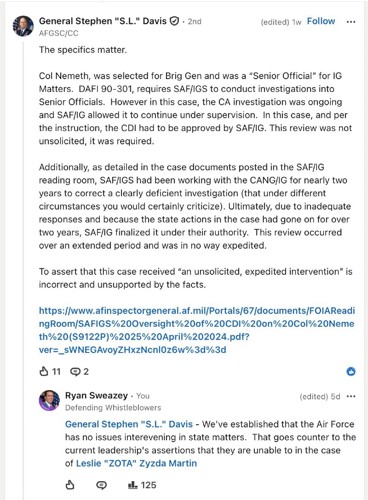 On this point, Sweazey says Davis is correct: “the Air Force absolutely does have purview, just as the Nemeth case demonstrates.” This raises the question Davis’ fellow officials have yet to answer: if the Air Force has no jurisdiction over Guard matters, how and why did its Inspector General exercise it, decisively, in a general officer's favor?
“When a three-star general calls to ask that a case be thrown out before formal review even begins, and the same department claims no jurisdiction in one officer's case while asserting sole authority in another's, that's not due process,” Sweazey argues. “That's all about who you know. And the reverse is just as true: when no high-ranking general picks up the phone to advocate for you, suddenly the same department that had jurisdiction for someone else, says it has none for you.”
“Taken together,” he adds, “the two cases expose an office that behaves less like the independent watchdog its charter promises and more like a courtier to whoever holds the most rank.”
Nemeth had a three-star general place a call on her behalf and came away with her record wiped clean. Zyzda-Martin had no one make that call — only a documented trail of communications between the officer who removed her and the husband of the very Inspector General meant to oversee such complaints — and came away with no explanation, no recourse, and no command.
“An Inspector General is supposed to answer to the evidence, not to rank,” Sweazey asserts. “What these two cases show is an office that finds the time, the authority, and the will to act when the right person in power calls and finds none of it when the officer calling has no rank left to spend. That's not independent oversight. That's a court jester to the powers that be — performing diligence for whoever's already winning and going silent the moment someone powerless asks for the same.”
Davis did not respond to requests for comment.
Editor's Note: It has been confirmed by an Air Force Public Affairs officer that Gen. Stephen Davis did not receive an email inquiry from J.M. Phelps, despite the email address being accurate.