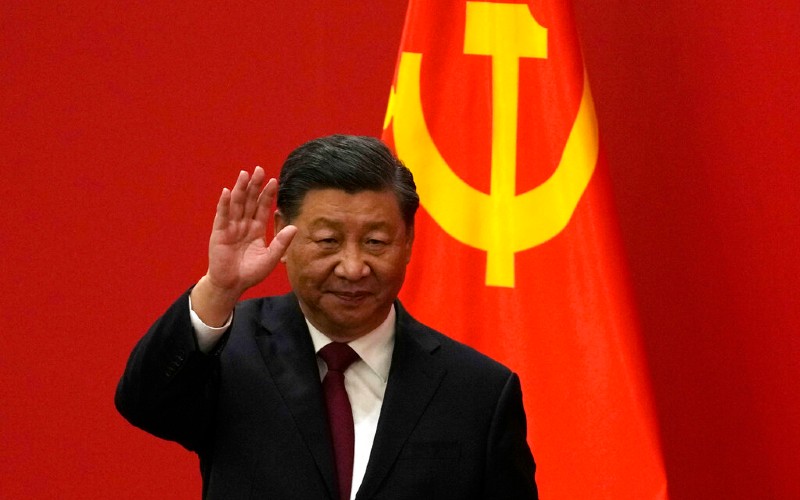



The news comes as President Donald Trump is scheduled to leave for China later today for talks with Xi Jinping, the general secretary of the Chinese Communist Party (CCP).
Wang, 58, was charged with acting as an illegal agent of a foreign government, a crime carrying a maximum penalty of 10 years in prison. The charges stem from activities that occurred from late 2020 through 2022, before she was elected to the Arcadia City Council in November 2022.
“We’re talking about an elected official in the United States whose loyalty wasn’t to her constituents. It was to the government of China. Literally, the People’s Republic of China bought a seat at the table in America’s local government,” Gerard Filitti, an attorney with The Lawfare Project, told show host Jenna Ellis.
 So the DOJ gathers up the alleged Chinese spy they know about.
“The question we have to ask is how many other seats they're currently occupying and how far these influence networks extend? This isn't new, but it really is shocking the extent of the power that some of these agents of China wield within the United States,” Filitti said.
The Justice Department alleges that Wang and her then-fiancé, Yaoning "Mike" Sun, operated a website called "U.S. News Center," which purported to be a news source for the Chinese American community. While running the site, they allegedly received and executed directives from PRC government officials to post pro-PRC propaganda.
Wang agreed to a plea deal and formally pleaded guilty. She resigned from her position as mayor Monday, the same day the charges were announced. Her co-conspirator, Sun, was sentenced to four years in prison in October 2025 for a similar charge.
Wang was born in China and moved to California at some point in the early 2000s.
“We're not clear whether she's a dual national or fully naturalized or not. We do know the U.S. government is looking at this as an espionage case or as a national security case, not just a disclosure case,” Filitti said.

A disclosure case may involve allegations such as failing to register as a foreign agent under the Foreign Agent Registration Act (FARA), hiding contacts with foreign officials or omitting information on security clearance forms.
Those can rise to felony-level offenses but are often treated as paperwork-related violations.
“This is something much more heinous. This is more of a national security investigation. It'll be interesting to see if there is a network, if there are other people across the U.S. who are implicated,” Filitti said.
Wang’s case should also cause government — local, state and federal — to take a much closer look at candidates for elected office.
The lesson being learned from this unfolding story is that candidate vetting needs more careful consideration.
The bar to clear should be values-based, not nationality-based, but vetting must be better from a standpoint of qualifying for elections and from the individual voter, Filitti said.
“There is a valid case to be made that we need to be more restrictive on who we put in office,” he said. “It speaks to the vetting problem that we have at all levels of government, even in the court system, the judiciary. We have to know well the people that we're voting for and we're appointing to these positions.”