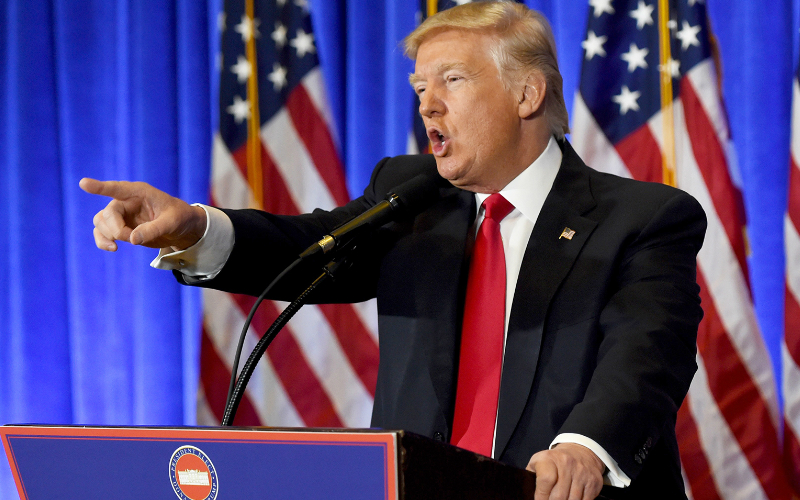



President Donald Trump is running out of patience with Iran. Though he did not elaborate, he said on Friday that he was "not satisfied" with Iran's latest proposal in their negotiations to end the war, rejecting the plan almost as soon as it was delivered.
In its 14-point proposal, Iran shifted its strategy by prioritizing a swift end to the ongoing regional war and a lifting of the U.S. naval blockade within 30 days. Unlike previous proposals that demanded immediate nuclear concessions or broad sanctions relief, this phased approach deferred discussions on Iran's nuclear program to a later stage.
Meanwhile, retired Navy Cmdr. Kirk Lippold, an adjunct professor at the United States Naval Academy, says the blockade is preventing Iran from selling its oil, which continues to hurt the Iranian economy.
By intercepting tankers and choking off ports, the blockade has slashed Iran's primary source of revenue, causing massive budget shortfalls, skyrocketing inflation (over 50%), a plunging currency, and widespread civilian hardship, The Wall Street Journal reports.

"I think the blockade itself is extremely effective," Lippold tells AFN. "We've essentially grabbed Iran by the economic throat, and we are squeezing them, and eventually they're not going to be able to continue to produce oil because they have nowhere to store it."
He explains that without anywhere to store the oil, the wells and the processing and piping facilities will have to shut down.
"When those things start to shut down, then you start having industry problems," he says. "You're going to reach storage capacity, and that's what the issue is going to be."
So even though Iran is still unwilling to negotiate, Lippold thinks the U.S. is making tremendous progress.
"We're going to continue to squeeze you economically, and your economy is eventually going to collapse," he warns.
Right now, the Islamic Revolutionary Guard Corps (IRGC) has taken over the government, and Lippold says the U.S. is building and developing that target "so that we can eventually take them out if we have to go back to kinetic operations."
"At some point in time, when the people aren't getting fed and the military is not getting paid, they're going to turn on the leaders," he predicts.
Major military expenses are necessary
Meanwhile, War Secretary Pete Hegseth and Joint Chiefs Chairman General Dan Caine are making the case for a $1.5 trillion military budget for 2027, including the multi-layered, $175 billion Golden Dome missile defense system.
Inspired by Israel's Iron Dome, President Trump wants to build the most extensive homeland missile defense system in history to protect the U.S. from potential threats from space and across the globe.
Bob Maginnis, president of Maginnis Strategies, LLC., says the idea is that we need a constellation of anti-ballistic missile sensors and systems in orbit and on land masses in Greenland and elsewhere.
"This will be expensive," he asserts. "It will take many years," but he agrees that it is necessary.

China and Russia have put offensive weapons in space, such as satellites with abilities to disable critical U.S. satellites, which can make the U.S. vulnerable to attack. In a joint statement last year, China and Russia called the Golden Dome idea "deeply destabilizing in nature," warning it would turn "outer space into an environment for placing weapons and an arena for armed confrontation."
Maginnis also supports other aspects of the budget proposal and the national security strategy Trump put out in December, which he says is all about strengthening America's hold on the Western Hemisphere against China, Russia and other threats.
"I think a larger Navy is necessary, given what the Chinese have been doing, and replenishing, obviously, our arsenals, which have been taking a major beating here for the last couple of months in Iran," Maginnis notes. "There's a lot of need."
China, which hopes to beat the U.S. to the moon, is also trying to discourage U.S. competition in artificial intelligence development.
Trump, who directed the Pentagon to pursue the space-based interceptors in an executive order during the first week of his presidency, has said he expects the system to be "fully operational" before the end of his term in 2029.