

The talks ended with claims of “significant progress” from leaders from Oman, who mediated the talks, and from Iranian officials.
“Good progress” was made, according to Iran Foreign Minister Abbas Araghchi.
However, no official statement has been released by the U.S. which continues to stockpile military assets in the Middle East which now amounts to the nation’s largest military build-up in the region since the U.S. invasion of Iraq in 2003.
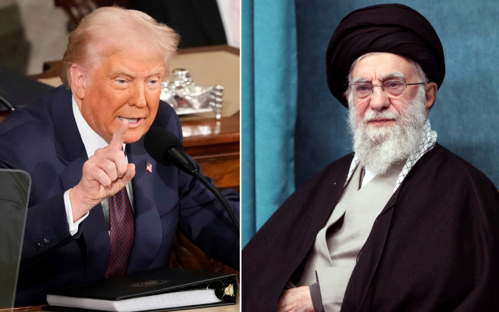 According to Iranian state media, negotiators insisted that Iran had the right to peaceful nuclear energy and rejected U.S. demands to completely stop the enrichment of uranium in Iranian territory and to transfer its stockpile of 400kg (880lb) of enriched uranium out of the country.
Further discussions are expected in Vienna next week which would include the International Atomic Agency (IAEA) involving experts on nuclear and sanctions issues.
Maginnis told “Washington Watch” host Tony Perkins the U.S. would do well to recall Ronald Reagan’s “trust but verify” approach from the late 1980s.
The former president used a Russian proverb — doveryai, no proveryai — to make his point with Russian President Mikhail Gorbachev at the time.
Ultimately, the Soviet Union accepted the presence of weapons inspectors, and a door was opened to transparency between adversaries.
U.S. diplomacy must trust by verify
Whether history repeats itself remains to be seen.
“The reality is that just like Reagan said, you need to verify everything, and unfortunately, unless they allow our inspectors in there such that we can trust to go to the facilities that we bombed last summer and to validate that they aren't active, that they haven't created a new enrichment facility, that they don't have a weapons program, then we shouldn't believe them,” Maginnis said.
Beyond the obvious one of military build-up, there are signs of a looming U.S. strike against Iran.
-- President Donald Trump on Feb. 19 issued a 10-15-day window for Iran to reach an agreement and avoid U.S. attacks. The deadline places the final decision window around March 6.
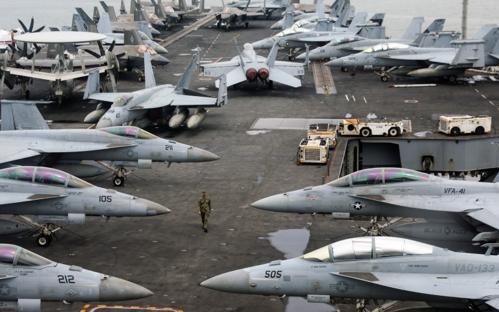
-- A second U.S. aircraft carrier, the USS Gerald Ford, has been deployed to the region to join the USS Abraham Lincoln. The second carrier, the world's largest, was set to arrive off the coast of Israel Friday.
 -- The U.S. State Department has authorized non-emergency level staff and families to leave Israel, and the U.S. Navy has reduced its staff at a naval headquarters in Bahrain
--- U.S. F-22 Raptor fighter jets, 11 in all, arrived Tuesday at Uvda, an Israeli air force base
-- U.S. Sec. of State Marco Rubio this week emphasized that Iran is not currently enriching uranium but wants it and is rebuilding toward that capability.
Speaking at the annual meeting of the National Religious Broadcasters in Nashville last week, longtime Israeli politician and diplomat Gilad Erdan called for U.S. strikes against Iran.
“Let's pray that President Trump is guided by wisdom from above, that he sees clearly the difference between illusion, danger, and evil and that he acts to protect freedom and secure a safer future for our children,” he told the NRB audience.
Erdan reiterated the threat posed not only by Iran’s nuclear program – which was weakened but not put out of commission by U.S. strikes against three facilities last summer – but by its ballistic missiles.
They threaten not only Israel, he said.
 “We are on the same continent for them, but they are meant for London, Paris, New York, and Washington. The Ayatollah regime is not just Israel's problem. It's the free world's problem,” Erdan said.
The U.S. remains adamant that Iran will not have nuclear weapons, and comments from Vice President J.D. Vance on Fox News Wednesday implied that Trump will use force without hesitation.
“We can’t let the craziest and worst regime in the world have nuclear weapons. That’s what the president has set as our goal. He is going to try and accomplish that diplomatically, but he has a number of other tools at his disposal to ensure this doesn’t happen. He has shown willingness to use them, and I hope the Iranians take it seriously,” Vance said.
The what’s next question
One major consideration faced by the U.S. as it ponders its options is what’s next for Iran? If its Islamic government, led by Supreme Leader Ayatollah Ali Khamenei and a key number of ayatollahs and Islamic scholars around him, falls, who takes over?
“Internal sources suggest 30,000-36,000 protesters have been killed by the regime,” Dr. Glen Duerr, an international studies professor at Cedarville University, told AFN last week.
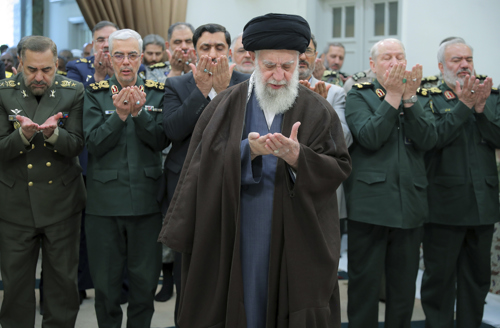 The protests and discontent with the Islamic government are at an all-time high, but there’s no clear leader among the protesters or any obvious choice to lead a post-regime Iran, Maginnis says.
The Islamic Revolutionary Guard Corp (IRGC), the elite force established after Iran’s Islamic takeover of 1979, could step into such a power vacuum.
With around 190,000 personnel, the IRGC controls ground, naval, air, and cyber forces, commands the Basij paramilitary militia, and oversees the Quds Force, which directs Iran’s proxy networks across the Middle East, including Hezbollah and the Houthis.
“There’s really not an organic movement inside that is organized and strong enough, in my opinion, to topple the regime. So it may be that we end up with maybe the mullahs going to exile, but the IRGC continues their authoritarian ways,” Maginnis said.