


U.S. Rep. Alexandria Ocasio-Cortez (D-NY) was part of the left-wing U.S. delegation that attended the Munich Security Conference. During the event, the socialist politician was well-prepared to mock President Trump and Republicans, but she was ill-prepared for a straight-forward foreign policy question.
“Would and should the U.S. actually commit U.S. troops to defend Taiwan if China were to move?” the Democrat was asked by Francine Lacqua, a Bloomberg Television anchor.
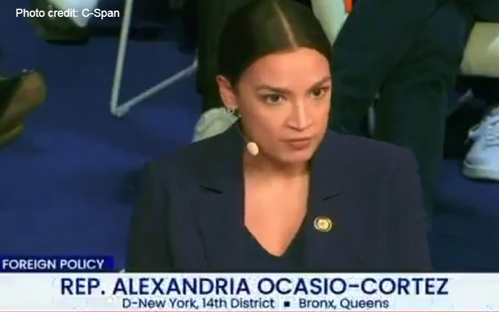 “Um, you know, I think that, uh, this is such a, a, you know, I, I think that this is a…ummm…this is, of course, a very longstanding policy on the United States,” she awkwardly told the interviewer.
Reacting to that reply, Washington Times columnist Robert Knight told American Family News the congresswoman’s “ineptitude” and difficulty with words reminded him of President Joe Biden’s own challenges.
“The fact that this woman is being touted as maybe the next senator from New York state, and a possible presidential candidate, is amazing,” Knight said. “She obviously doesn't have the mental capacity to think big and govern the rest of us."
The second portion of AOC’s answer about Taiwan, which wasn’t as painfully awkward, was a word salad that never answered the important question.
“I think what we are hoping for,” Ocasio-Cortez continued, “is that we never get to that point, and we need to make sure we are moving in all of our economic, research, and global positions to avoid any such confrontation.”
Reacting to that response, Knight echoed the views of others: It reminded him of Kamala Harris attempting to skirt around a question with slogans and catchphrases.

“She serves up word salads that Kamala Harris might even envy,” Knight said. “This is when someone spouts slogans and phrases that amount to nonsense, but it might sound good to intellectuals who think it’s so deep we poor peons can't understand it."
After being quoted in the news media for that answer, and for incorrectly stating Venezuela is located below the Equator, Ocasio-Cortez complained to The New York Times about how she was being portrayed.
Taking a 10-second clip of her comments, she said, distracts from the "substance of what I am saying," she told the Times.
Rubio warns Europe in diplomatic comments
In a previous story, AFN reported Secretary of State Marco Rubio also spoke to Europe’s political leaders over the weekend. The top U.S. diplomat attempted to warn Europe of its gradual but steady decline of its own culture and its native population.
“We are part of one civilization – Western Civilization,” Rubio said. “We are bound to one another by the deepest bonds that nations could share, forged by centuries of shared history, Christian faith, culture, heritage, language, ancestry, and the sacrifices our forefathers made together for the common civilization to which we have fallen heir.”

Despite the serious topics Rubio raised in his speech, Curtis Houck of the Media Research Center says most liberal news outlets gave it little attention over the weekend. Most of the Sunday news shows omitted it entirely, and the “Face the Nation” show on CBS only gave it a passing mention.
Asked why Rubio's speech went ignored by the news media, Houck said that’s because reporting on the unifying tone portrays the Trump administration in a positive way.
“I think what the media want is they want to paint an administration that is bombastic and is angry, haphazard, and divisive,” Houck complains, “when the secretary's speech made clear that's not what they're looking for as an administration.”
Rubio's speech in Munich was considered a more diplomatic warning than last year's speech by Vice President J.D. Vance. Vance warned Europe's leaders they were slipping into an authoritarian state, where free speech was being banned online if a stated opinion goes against the state's approved narrative.