
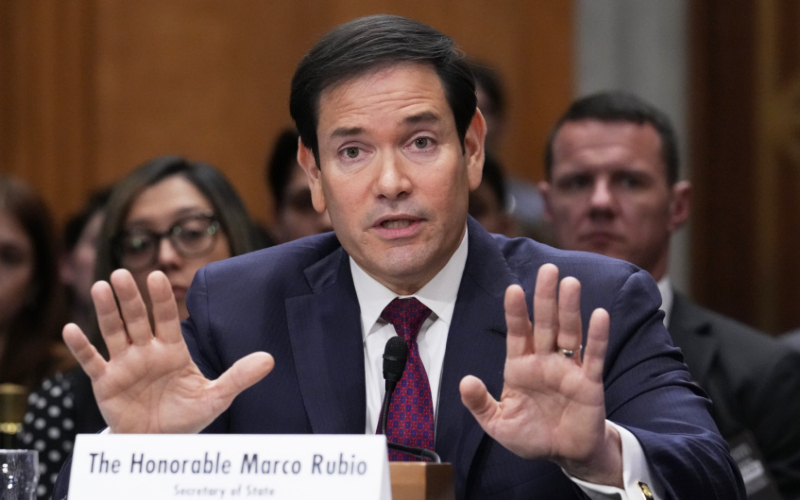
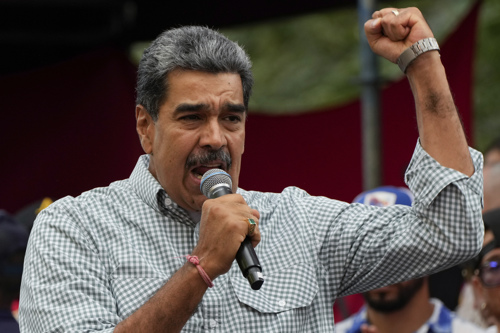
Secretary of State Rubio appeared before a Senate committee Wednesday, updating lawmakers on the status of Venezuela almost a month since Jan. 3. That is when the U.S. launched a secretive, large-scale military operation that captured former President Nicolas Maduro and his wife, Cilia Flores.
The action involved coordinated airstrikes and a precision assault on Maduro’s compound in Caracas, after months of planning and intelligence work.
 From the U.S. perspective, control or influence over Venezuelan resources and politics can shift the balance in western hemisphere geopolitics and global energy markets -- especially amid competition with China and Russia.
Venezuela’s oil reserves of more than 303 billion barrels rank first in the world.
The United States had previously indicted Maduro on criminal charges (including narco-terrorism and drug trafficking) in federal court, and a longstanding reward had been offered for information leading to his arrest.
After his capture, U.S. authorities brought Maduro and Flores to New York to face those charges.
“There are few people in the administration I think are in a position to communicate the priorities of the Trump administration accurately, calmly, and as sophisticated as Marco Rubio,” Grantham told show host Jenna Ellis.
Sen. Tammy Duckworth (D-Illinois) may or may not agree, but after Wednesday's meeting the record shows Rubio, poised and focused, repeatedly deflecting Duckworth's attempts to light the fuse on a narrative that says the U.S. is at war with Venezuela.
Venezuela’s interim government
In the wake of Maduro’s ouster, Venezuela’s Supreme Tribunal of Justice (TSJ) designated Delcy Eloina Rodriguez Gomez as acting president.
Rodríguez had been part of Venezuela’s socialist leadership for decades, holding cabinet posts and top state roles under Hugo Chávez and Maduro.
Immediately after Maduro’s capture, Rodríguez (pictured below) condemned the U.S. military operation, calling it illegitimate and a violation of Venezuela’s sovereignty. She initially insisted Maduro remained the legitimate president and criticized Washington’s intervention.
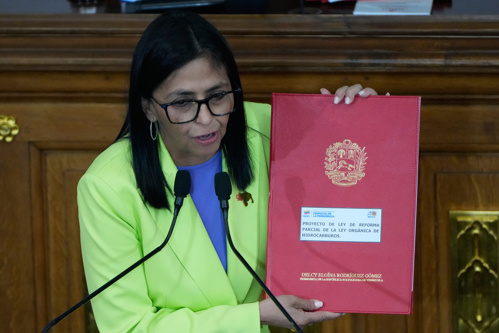 In the days that followed, Rodríguez publicly adopted a more conciliatory tone, offering a framework for “cooperation” with the United States emphasizing peaceful coexistence and mutual respect, though still asserting Venezuela’s sovereignty.
Rubio refused to be backed into a corner on future U.S. plans in Venezuela. He didn’t call for military action but also didn’t rule it out.
“I can tell you right now with full certainty, we are not postured to, nor do we intend or expect to have to take any military action in Venezuela at any time,” Rubio said.
However …
“Make no mistake, as the president has stated, we are prepared to use force to ensure maximum cooperation if other methods fail,” he added.
Rubio’s refusal to eliminate military options from future U.S. planning has come off as some sort of “maddening phrase” and “something more extreme than it actually is. He’s merely saying, ‘you’re not going to hem us in. Those are our options,’” Grantham said.
Senators aren’t accustomed to such tone in conversation.
“This movement from dialogue and talking to action always scares elected officials. They live in a world of issuing statements and things of the like. So, to have a president so action-oriented always startles people,” Grantham said.
 Rubio clearly explained the administration’s position, the arrest warrant for Maduro that was already in place, why the operation was necessary and goals for next steps.
“He was able to navigate and keep open the options of the administration and didn't fall victim to making promises or letting them hem in the administration to those senators’ wishes.”
Next steps for the U.S. include reopening diplomatic channels with Venezuela’s interim government, pushing that government toward political and economic reforms and providing oversight of the management of oil reserves.
Pushing for democracy in Venezuela
Rubio said the administration will seek to push Venezuela toward a democratic transition, describing the Maduro regime as "a base of operation for virtually every competitor, adversary and enemy in the world."
He made it clear Rodriguez will not remain in power but did not say how long she’ll be around.
"I can't give you a timeline of how long it takes. It can't take forever," Rubio said. "But it’s not even been four weeks."
He said the U.S. is aiming for a "friendly, stable, prosperous Venezuela and democratic… with free and fair elections," while acknowledging the process will take time.

Sen. John Cornyn (R-Texas), a guest on Washington Watch Wednesday, told show host Tony Perkins the early days of the Rodriguez government have been “a great success so far.”
U.S. influence is important to off-set the influence of America’s enemies in oil-rich Venezuela.
“Venezuela has sort of been a scorpion's nest of problems, our adversaries like Iran, Russia and China and Cuba all conspiring there, particularly Iran, with the Hezbollah base there,” Cornyn said.
Hezbollah, an Iranian proxy, has used drug proceeds to fund attacks against Israel, the senator said.
“Over time, we'll see more democratically elected officials take charge. Maduro and Chavez before him created a police state there. They killed all their competition and surveilled all their citizens and impoverished them all, so they don't have any institutions or actually any leaders that can fill that gap immediately,” Cornyn said.
The truth about oil
Oil has been a hot topic, a topic that sells for opponents of the administration. The fact that the U.S. ranks No. 3 among the world’s oil exporting countries takes the teeth out of that argument, Grantham said.
“People were trying to use oil as a as the reason for invasion which sells well publicly but on its face is kind of silly. We don’t need oil,” he said.
But lots of nations do.
U.S. involvement in Venezuelan oil will ensure that the country’s richest resource will be used to help it rebuild.
“It’s really the only way to build back their economy. Rubio explained that there will be funds that are slated specifically for rebuilding that capacity for selling the product and selling it at fair market value, not cheaply to cronies and adversaries like China, but allowing people around the world to purchase Venezuelan oil at market price,” Grantham said.