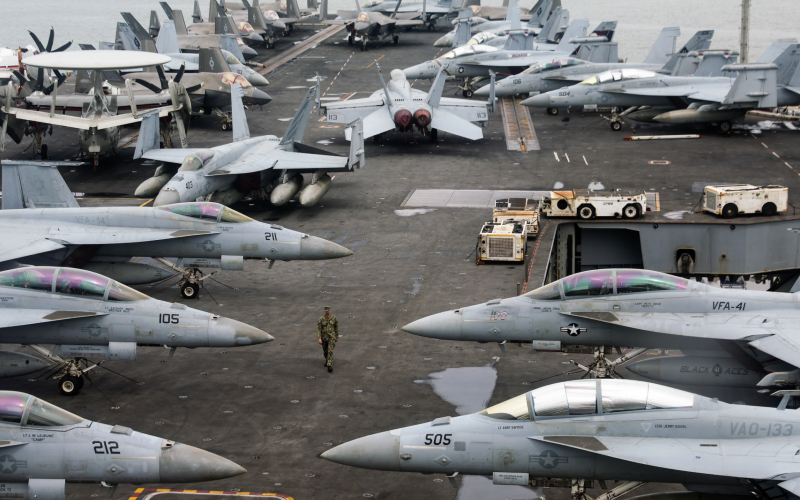


Last week, sources informed Fox News that at least one U.S. aircraft carrier is being deployed to the Middle East as tensions with Iran escalate. Air, land, and sea resources of the U.S. military are anticipated to be deployed to the area in the upcoming days and weeks. To that end, it remains uncertain if the carrier is the USS Abraham Lincoln, which is currently active in the South China Sea, or one of the two carriers on the move from Norfolk or San Diego.
American Family News spoke to retired U.S. Army Lt. Col. Darin Gaub. The former UH-60 Black Hawk pilot and battalion commander said that, based on the available evidence, “it is possible that the U.S. would take unilateral action if necessary.”

He provided one reason he believes the U.S. may seem ready to act unilaterally. He argued that an Israeli strike on Iran could lead to negative repercussions due to the fragile nature of Israel's relationships within the region.
However, Gaub still expects “there would be a flavor of Israel in the background regardless.” He explained, “Israel has excellent intelligence on Iran, and it is likely that if the U.S. did take action, [any military action] would incorporate intelligence gathered by Israel to ensure the greatest chance of mission success.”
Maginnis: Give guns to IraniansA national defense analyst says that arming the citizens of Iran who are being slaughtered by the tyrannical regime is a viable option. A radical Islamic cleric while leading prayers in Tehran, demanded the death penalty for protestors detained in a nationwide crackdown. And Ahmad Khatami's sermon carried by Iranian state radio also directly threatened U.S. President Donald Trump, who has warned the regime of possible U.S. military intervention if the executions continue. Bob Maginnis is a national defense analyst and president of Maginnis Strategies, LLC. He thinks one option is arming the insurgents, which has been successful in previous operations in the Middle East. "We armed the Mujahdeen during the Soviet occupation of Afghanistan and eventually ran them out. The Iranians armed Shia militia while we had a large footprint in Iraq and killed a lot of us. It's tit for tat. it's what you do as a covert operation. You arm the insurgencies. So that makes perfect sense, they're blended in the population. They would fight the Basij and the IRGC and the police forces, as long as there's plenty of Iranians to man those weapons, and I suspect that there are." AFN |
In his opinion, “The U.S. should only provide military support if diplomatic and economic measures were unsuccessful, or if the Iranian regime began to purge large segments of its own population.”
And that military support should be “discreet, effective, target only regime functions, and not risk broad escalation.” There is no necessity for any “boots on the ground” in Iran, asserted Gaub. “We should also make sure it's clear we are helping the Iranian/Persian people and don't wish to harm them, or the infrastructure they need to be economically successful if they throw off their dictators.”
He pointed out that a regime change in Persia led by Persians would have significant implications across Asia and the broader Middle East. “The Persian people have the best chance in decades to help chart a new course,” he stated.
Gaub also remarked, “The United States must look at this as an opportunity to significantly improve a large and volatile part of the world.”