


The SAVE America Act, which would require proof of citizenship to register to vote and photo ID to vote, has been passed twice by the U.S. House but remains blocked by a filibuster in the Senate.
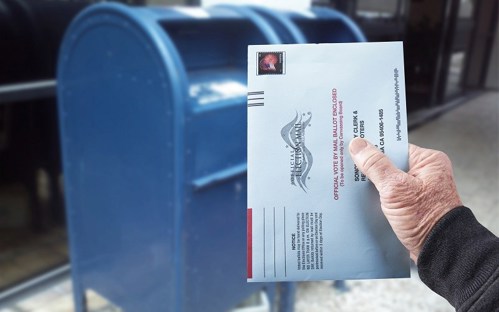
President Donald Trump has long claimed that mail-in voting, with a post-election grace period that varies wildly among states, is ripe with election fraud.
Monday, he told reporters in the Oval Office the Supreme Court’s 5-4 decision allowing states to count mail-in ballots as long as they are postmarked by Election Day just offers “more time to vote illegally.”
 He used the decision as an opportunity to call for Senate passage of the SAVE America Act calling it “more important than ever.”
John Roberts, the chief justice, and Amy Coney Barrett, often reliable votes on conservative issues, were not in this instance.
Barrett authored the majority opinion and stated “election-day statutes require the electorate’s choice to be made on election day,” which she says occurs when voting ends, not when ballots are physically received by officials.
The decision upheld a Mississippi law that allows ballots to be received up to five days after Election Day.
Other states are much more liberal with extended time. New York, California and Oregon allow seven days, Illinois 14 and Washington 21.

Hans von Spakovsky, the senior legal fellow with Advancing American Freedom, told show host Jenna Ellis the Justices delivered a “very bad opinion” describing Barrett as a rookie still finding her way.
“You go from what Amy Coney Barrett writes and then you go to Justice (Samuel) Alito's (dissenting) opinion, and it's so clear that Alito knows so much more about election laws in this country, about our historical practice of how we've been conducting elections, and Amy Coney Barrett comes across as an amateur frankly in comparison,” Spakovsky said.
Alito (pictured at right) argued that accepting late-arriving ballots "effectively postpones the date on which the electorate's choice is made," violating federal law and risking public confidence in elections.
 He was joined in dissent by Justices Clarence Thomas, Neil Gorsuch and Brett Kavanaugh.
The dissenters maintained that historical practice and statutory text require the collection of ballots to be completed on Election Day itself.
“The logic in her opinion to me just doesn't make sense in particular. Her whole case is based on the idea that Election Day only applies to the electorate making their choice. Well, that's not true,” Spakovsky said.
Not all red states line up with Trump on this issue, Mississippi’s signature case being a prime example.
Texas and West Virginia also allow a grace period, West Virginia with five days and Texas with just one day.
A conservative consolation prize?
The “saving grace” in the decision is that Barrett made it clear the justices were only interpreting the three federal statutes pertaining to a set election day and were not looking at constitutional issues, Spakovsky said.
That means Congress could change the federal statutes.
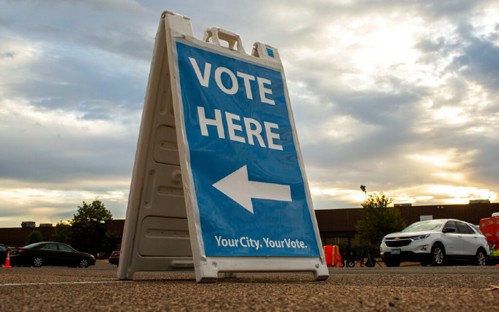 “The SAVE (America) Act would in fact change federal law and say mail-in or absentee ballots have to be in the hands of election officials by the end of Election Day,” he said.
But that key election integrity legislation remains stalled as Senate Majority Leader John Thune says he can’t muster the necessary 60 votes to beat the filibuster or even the 51 votes to change the rules. A number of Republicans hold strong to preserving the historic minority party tool.
Thune told Fox News, "If the result is only achieved by nuking the legislative filibuster, we don't have the votes to do that, and so that's not a realistic option."
The little consolation offered by the ability, on paper, for Congressional tweaks doesn’t do much to shine up the Court’s less-than-stellar effort, Spakovsky said.
“How could you decide this? You're clearly wrong as Alito said on historical practices prior precedence and the statutes themselves,” he said.