


Doing that requires removing illegal aliens from the nation’s population count, she said on American Family Radio Tuesday.
Currently, the Census Bureau includes all people residing in the U.S. regardless of citizenship or immigration status.
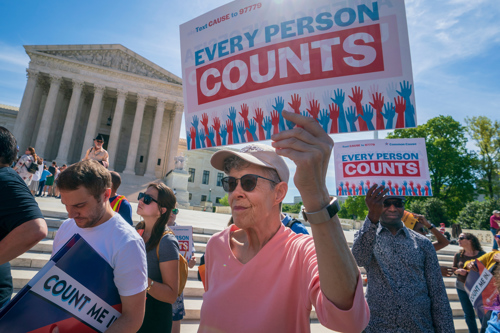 Hanaway’s lawsuit also asks for a recount of the 2020 Census – without illegal aliens.
The Constitution states that the “whole number of free persons” should be counted “excluding Indians not taxed.”
During his first term, in a July 2020 memorandum, President Donald Trump directed the exclusion of illegals from the national count, a position upheld when the Supreme Court voted 6-3 to dismiss the case as “premature” citing the government’s lack of finalized implementation data. No concrete method for identifying illegals had been presented, the Court said. The Court did not rule on the legality of the policy itself.
Months later, President Joe Biden, whose term would see the arrival of millions of more illegals, instructed that illegals be counted.
States’ seats in the House of Representatives, which total 425, are determined by population.
California currently dominates the House of Representatives with 52 seats. Trailing in second, far behind, is Texas with 38 seats.
The removal of illegals from the count would result in another seat for Missouri, Hanaway told show host Jenna Ellis.
“The city of Los Angeles alone has 2 million illegal immigrants. By comparison, Missouri's total population is 6.1 million people. It obviously is costing Missouri tremendously for those 2 million illegal immigrants in Los Angeles to get counted in the census,” Hanaway said.
I t’s not only about the U.S. House seat but would also mean “millions” in federal dollars. Inclusion in the count also means illegals, even if they don’t vote, are indirectly influencing presidential elections.
“For every congressional seat, you get one electoral vote. So, this really would be a shift from the power on the Coast,” Hanaway said.
The lawsuit asserts that including undocumented immigrants "steals federal representation" from states like Missouri and transfers it to states, such as California, with larger immigrant populations
Hanaway cites constitutional concerns and references a 1992 Supreme Court case, Franklin v. Massachusetts, to support the claim that only domiciled citizens and lawful residents should be counted.
In that case the Court ruled on a dispute arising from the 1990 census, where overseas federal employees -- mostly military personnel -- were counted as residents of their U.S. "home of record." This allocation caused Massachusetts to lose a congressional seat to Washington State. The Court ruled with Massachusetts.
The lawsuit was filed in the Eastern District of Missouri, and because it’s a state’s challenge to “apportionment” will go directly to the Supreme Court on its first appeal, Hanaway said.
Pushing for a resolution
It’s not expected to impact the 2026 midterm elections, but she holds out hope.
“So, timing wise, I think we probably are not going to be able to resolve this until the time for the 2028 elections. But we're trying to push as hard as we can and maybe even have an impact this year,” she said.

The issues requires a legal resolution to protect states’ rights well into the future, Hanaway said.
“As soon as Biden got in office, he reversed (Trump’s instructions) and counted illegal aliens. So that's part of why we needed to file suit. We know President Trump's going to do the right thing. But we don't know that any president after him will do the right thing.”
The status of illegals in the count has seen ebb and flow through the years.
“Nobody had the audacity to count illegal immigrants until Jimmy Carter. Then Reagan got us some real immigration reform and things, calmed down for a while. Now I think it all has come to a head because Joe Biden just opened the borders,” Hanaway said.