

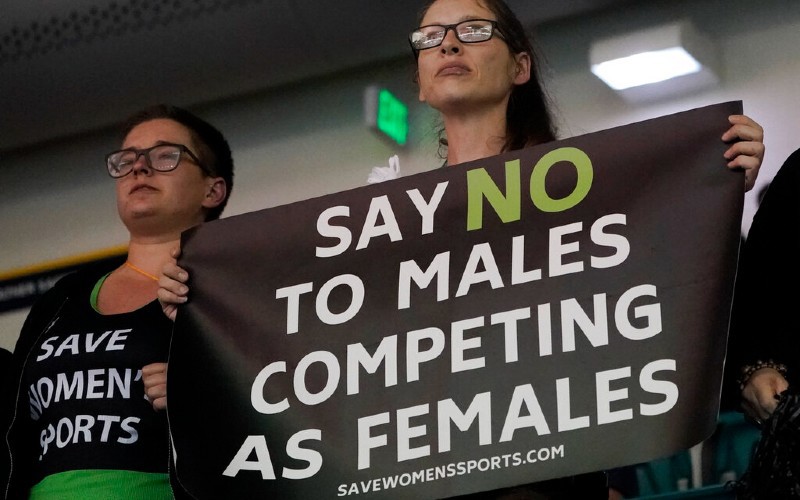
 The justices heard arguments from two states, Idaho and West Virginia, after lower courts have sided with transgender females – males – who demand the legal right to compete with and compete against female athletes.
The two cases argued Tuesday, Little v. Hecox and West Virginia v. B. P. J. came before the justices after transgender athletes, citing the Equal Protection Clause in the U.S. Constitution, sued to block them.
The law in Idaho, which dates back to 2020, is the Fairness in Women’s Sports Act. West Virgina’s state law, which went into effect in 2021, is the Save Women’s Sports Act.
 SCOTUS Blog, the popular legal website, was among the legal sources that predict a win for the states, and for female athletes, after arguments concluded. In her story, SCOTUS Blog reporter Amy Howe wrote a majority of the nine justices “appeared to agree with the states that the laws can remain in place, even if it was not clear how broadly their ruling might sweep.”
Howe’s story pointed to comments from Justice Brett Kavanaugh and from Justice Amy Coney Barrett that leaned in favor of Idaho and West Virginia.
For the court’s liberal justices, Howe wrote the challengers “faced an uphill battle” and devoted much of their efforts at the hearing to “mitigating their losses.”
 Justice Barrett was criticized by some conservative observers, however, after using the terms “trans girls” and “cisgender” during oral arguments. Those terms are considered biased, political language, such as the justices using the term "pro-choice" in a case over abortion.
“It seemed an unnecessary concession to the left’s new-speak on gender,” Sarah Parshall Perry, an attorney at Defending Education, wrote on X.
Asked what comments stood out to her, Alleigh Marre, executive director of American Parents Coalition, also recalled a comment from Justice Barrett. Despite using the other side’s terms, Barrett also questioned if the state laws are actually "discriminatory" when males still have an ability to play on boys' teams.
"So, you can't claim with a straight face that it's discriminatory when that door is not closed," Marre, a mother of four, with two daughters, told AFN.
 The right-leaning justices currently hold a 6-3 majority on the court but legal analysts were watching one of them closely, Justice Neil Gorsuch. That’s because Gorsuch surprised many in 2020 when he wrote the majority opinion in the Bostock opinion, a discrimination case involving a transgender-identified employee.
A story by The Federalist complained Justice Gorsuch stated during arguments that people who identify as “transgender” should be considered a “discrete” group because of a history of discrimination against them.
 Among the court's most reliable conservative justices, Justice Samuel Alito (pictured at right) was praised by many for confronting an ACLU attorney, Kathleen Hartnett, over defining male and female.
"For equal protection purposes, what does it mean to be a boy or a girl or a man or a woman?" Alito pressed Hartnett.
When the attorney admitted she "did not have a definition for the court," Alito pointed out the obvious.
"How can a court determine whether there’s discrimination on the basis of sex," he replied, "without knowing what sex means for equal protection purposes?"

Marre told AFN she is hopeful the justices will side with female athletes, but she realistically understands nobody really knows how the court will rule.
"What does give me some faith,” Marre said, “is seeing organizations as far left as even The Washington Post having editorials making the case for the Supreme Court to protect Title IX in its current form.”
At the Republican-hating newspaper, The Washington Post's editorial board raised eyebrows Tuesday when it wrote the Supreme Court "has the chance this week to save women's sports" in the two legal cases.
By ruling on behalf of female athletes, the unexpected editorial states, the court can "restore a level playing field for girls by excluding biological men and thereby correcting one of the worst excesses of America's cultural revolution."