


U.S. forces struck two Iranian rocket-missile launchers on Larak Island Sunday. The result wasn’t widespread devastation but very targeted success as Iran sought to reengage with its greatest strength in the conflict — the Strait of Hormuz.
Two launchers were destroyed or disabled, the U.S. military said.
The U.S. had announced that it had recently cleared Iranian mines from the shipping lanes. Washington apparently concluded that the Iranian Revolutionary Guard Corps (IRGC) was preparing to put mines back into the water, prompting the strike.
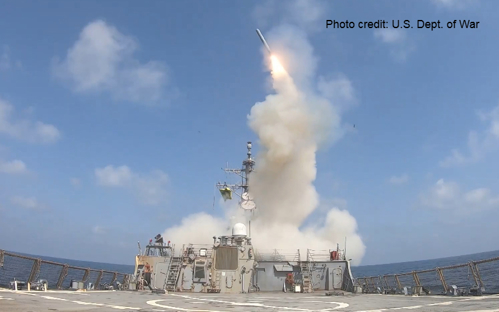 So, in effect, the U.S. destroyed Iran’s immediate capability, rather than trying to inflict broad damage.
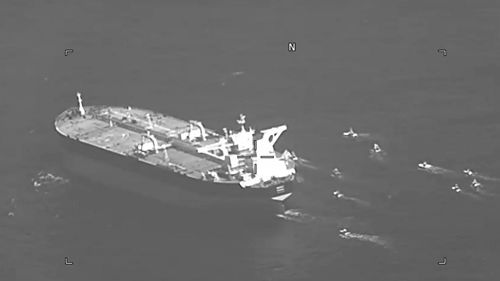
Larak sits just off Iran’s southern coast and overlooks the Strait of Hormuz. Iran has been using missile, rocket, drone and naval capabilities in the area to discourage commercial shipping and disrupt economies worldwide.
Iran subsequently fired ballistic missiles at U.S. facilities in Jordan. Most or all of those missiles were intercepted, with no significant U.S. casualties or damage publicly confirmed so far.
A day after the Iranian launches, President Donald Trump declared in a Truth Social post that “Iran is officially a failed nation. IT IS DEAD.”
Trump said Iran has no Navy or Air Force and is not paying its soldiers or police as inflation has risen, he says, to 300%.
“Their leadership is in total disarray and incapable of properly representing the country,” he wrote.
A winning silence?
The attacks interrupted a relatively quiet time of media coverage during the U.S.’ ongoing economic warfare. That silence is important.
“It’s another sign that the war is going well,” Scott Uehlinger told show host Jenna Ellis. “The war is being won slowly through economy, through blockade, the same tactic that starved Germany in World War I, the same tactic that starved Napoleon in 1812. It’s very effective.”
Iran may not be unraveling at the pace the president implies, but Uehlinger believes the end could be very close.

If so, the end could be due in part to efforts to decrease global reliance on the Strait of Hormuz to export oil. That key leverage point may be starting to slip somewhat.
Iran’s ability to threaten world markets through what amounts to Hormuz terrorism is lessening as some of its Persian Gulf neighbors are making moves.
Saudi Arabia has demonstrated that it can move a very substantial amount of oil around Hormuz through its East-West pipeline to Yanbu on the Red Sea.
The pipeline has been expanded to about seven million barrels per day, and during the crisis Saudi Arabia has actually used it heavily. Reuters reported that Saudi Arabia is considering adding another two million barrels per day of capacity.
The ability of Red Sea export terminals to load all the oil at once remains a question mark.
The United Arab Emirates (UAE) already has the Habshan-Fujairah pipeline, which carries oil from Abu Dhabi across the country to Fujairah on the Gulf of Oman — completely outside the Strait. UAE is working to complete a second pipeline that could go online in 2027.
 It can handle roughly 1.5-1.8 million barrels per day.
Iraq has been hit particularly hard by the Hormuz blockade, with production falling more than 50% in June to 1.9 million barrels per day compared to 4.2 million before the war. The U.S. is supporting Iraq’s effort to rehabilitate a decades-old crude pipeline from its northern Kirkuk field through Syria to the Mediterranean, a project that could begin construction as early as 2027.
“What we’ve seen in slow motion is pipelines have been starting to supplant the Strait of Hormuz. It’s maybe 30%of the deliveries are now via pipeline or more,” Uehlinger said.
The Hormuz long game
Replacing the Strait of Hormuz is the long game.
“It’s increasing. What’s it going to look like in five years? It’s going to be considerably different. Maybe instead of moving 20% of the world’s oil it’s moving 10%,” he said.
The more the pipelines come into play, more pressure is brought to bear against the Iranian regime.
“Iran is running out of cards. Apparently now it's 2 million riyals to the dollar, and basic groceries are getting hard to find in Iranian shops. It’s very possible that we’re coming to the end of this,” Uehlinger said.