


“You have a two-headed monster here," Ryan Walters, who leads Teacher Freedom Alliance, says of the U.S. Department of Education and two powerful teachers’ unions.
Those teachers’ unions are the National Education Association, or NEA, and the American Federation of Teachers, the AFT.

Walters, who previously served as Oklahoma’s state education superintendent, is an outspoken critic of teachers’ union as well as an advocate for parental rights and school choice.
He wrote a recent Fox News op-ed in which he argues the government shutdown exposed how useless the DOE really is. Public schools across the country are still operating, he writes, because the bureaucracy at the DOE isn’t involved in their day-to-day operations.
“The shutdown proved what many of us already knew: states are not only capable of managing education, they already do,” he writes.
NEA lobbied Carter for a DOE
In the article, Walters also ties the U.S. Department of Education to the teachers’ unions. He correctly recalls some political history: President Jimmy Carter’s creation of the federal department, a law he signed in 1979, was a political favor to one of the teachers’ unions.
In fact, it was the NEA that successfully lobbied then-candidate Carter in 1976 to establish a federal department of education. During the campaign, the union gave its first-ever presidential endorsement to Carter for his promise to do so.
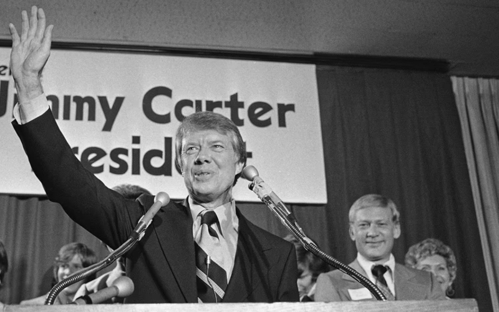 According to a related historical article, by education website The 74, the establishment of a federal education department was opposed by the AFT. That's because the NEA was the bigger union at the time, and the AFT correctly feared its bigger competitor would use the new federal agency to increase its political power.
That fear was not unfounded. According to the NEA, it has 2.8 million members and more than a half-billion dollars in annual revenue. The second union, the AFT, claims to have 1.8 million members with an annual budget that tops $200 million annually.
With both teachers' unions lobbying Congress for and against a new federal agency, what would become the U.S. Department of Education came to be after a vital 20-19 committee vote in the U.S. House. The final vote for the new federal department was widely split among both political parties, with some liberal Democrats opposing it and conservative Republicans supporting it.
 During the 2024 elections, however, both teachers’ unions spent a combined $39.2 million on political spending in which the Democratic Party benefitted from 98% of those political donations.
With the U.S. Department of Education now a target for closure, Walters says Republican politicians should “grow a backbone” and target the two teachers’ unions that still work closely with that federal agency.
"The reality is the teachers’ union will pull out any stop, they will use any bullying tactics,” he says, “but the people of America are behind you.”