

Every year, Operation Christmas Child (OCC) delivers shoeboxes to children around the world.
Beginning in the United Kingdom by Dave and Jill Cooke in 1990, the Wales-based shoebox project became affiliated with Samaritan’s Purse in 1993. The late Pastor Ross Rhoads and his congregation at Calvary Church of Charlotte were responsible for helping to pack the first shoeboxes that year, collecting 11,000 shoeboxes within several weeks. That year, OCC delivered 28,000 shoeboxes to Christians in the Balkans.
As of 2025, OCC has delivered shoeboxes in over 170 countries and territories to more than 232 million children.
Individuals and church volunteers come together to pack shoeboxes, which are sent out to one of the eight processing centers around the U.S. While collection happens though the Thanksgiving and Christmas seasons, distribution of the presents happens through late December through spring of the next year, due to clearing customs and traveling through rural areas.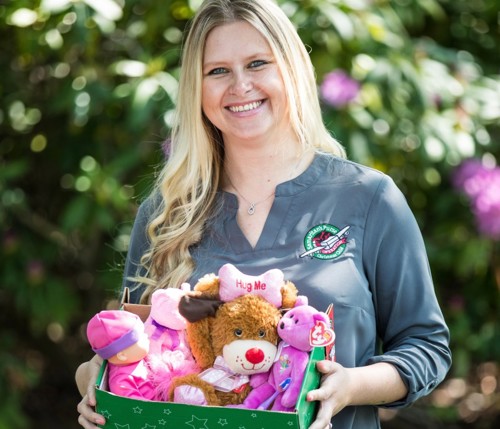
Many people may ask “why shoeboxes?” According to OCC, “shoebox gifts demonstrate God’s love in a tangible way to children in need around the world.” Along with toys, hygiene items, and school supplies, the children also receive an evangelistic booklet called “The Greatest Gift” and can participate in a 12-lesson discipleship program called “The Greatest Journey.”
The influence of these boxes has certainly reached far and wide. American Family Radio (AFR) spoke with a couple past shoebox recipients, both who now work with Operation Christmas Child today.
Soviet Union
Eventually, Elena Nicholson (above right) would be adopted by a Christian family in Missouri. As a young child, she grew up in a small town in the former Soviet Union with her younger sister Yulia. Living in a broken home, her parents were paid in alcohol instead of food or money. A day of work was a day of drinking, and Nicholson’s father became very abusive.
“Every night when they would come home, you could kind of feel the darkness coming over our house,” says Nicholson. “By the age of eight, my parents were caught stealing some items, and they were put into prison. Myself and my sister, we were put into our first orphanage.”
According to Nicholson, the orphanage was like a safe haven compared to their previous living situation, and they stayed two years before transferring to another. The sisters still had the same benefits, but something was missing.
“We had the food, we had the caregivers, we had a school, but the things that we did not have, we did not have the love,” tells Nicholson.
It was at this second orphanage that Nicholson and her sister received their first shoeboxes.
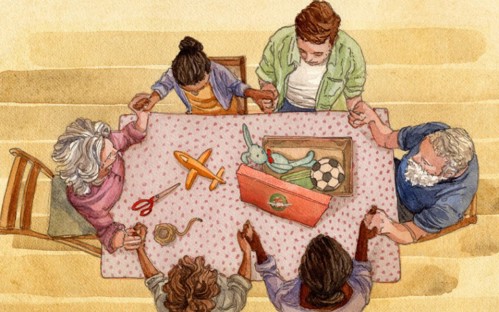 “That was a miracle in itself, because until that point, we have never received a gift before. When I actually held the shoebox in my hand, it was an amazing thing, in a sense that it was wrapped in a colorful wrapping paper, it was bright, it was shiny, it was like the coolest thing that I had ever seen,” reveals Nicholson.
Two separate reasons stopped Nicholson from immediately opening the box.
First, she did not think that whatever was inside would measure up to the outside of the box. Second, because she wanted her sister to have the best, Nicholson saved her box to give to Yulia in case she did not like what was in hers.
“When my sister opened her shoebox, she was in love with it because everything in her shoebox was artistically related to a girl of her age, which is fantastic,” states Nicholson. “When I was watching my sister, pulling one item after another out of her shoebox, her smile just grew bigger and bigger.”
This was all the encouragement Nicholson needed to open her own box. As she describes, the shoebox was “literally glowing pink from the inside out,” which happened to be her favorite color.
“The coolest thing about it is just the fact that God knew that about me, and He gave me a shoebox of color pink,” states Nicholson.
But that is not all. She received socks that would help on cold nights, a teddy bear, and a Barbie with a sparkly pink dress.
“One of my favorite things I got in my shoebox was a pink pen, and it was fascinating because this pink pen had a fluffy on top and a wire and a heart that would jingle on it. I've never seen something like that before,” says Nicholson. “Looking back now, when the heart of that pen lit up, my heart lit up for the first time because in reality, by that point between the age of 10 to 12, I felt like I was unloved.”
Nicholson explains that, at the time, she felt like a nobody who was just taking up space. However, receiving a shoebox with her favorite items made her feel loved by someone she had never met.
“They took the time and packed a box for me with my favorite things. And that feeling of that love and acceptance from a stranger, that was an amazing feeling in itself,” says Nicholson.
Romania
Another person who was greatly impacted by OCC was Izabella McMillon (below right), who grew up in the communist state of Romania. Every aspect of her life was controlled by the government as her family was told where to live, where to work, where to attend school, and where to grocery shop.
“But the biggest thing the government was trying to control is to make sure that God's name was not known in our country. Saying the name of God out loud or owning the Bible, those things could cost our lives,” says McMillon. “That was the environment that we grew up in.”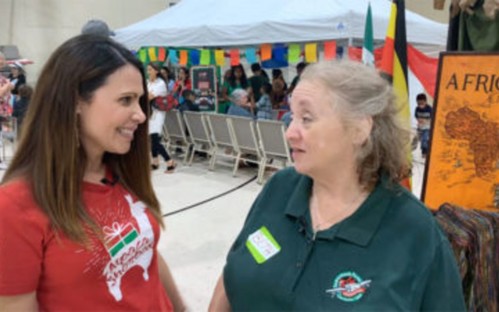
McMillon and her brother were exposed to the gospel by finding a hidden Bible under the floorboards of their government owned apartment. They also attended an underground church where the pastor read the Bible to children under the pretext of story time. Understanding that there was something more to it, she asked the pastor to teach her how to pray. As a 13-year-old at the time, McMillan wanted to pray for snow.
However, her prayer was not answered until three months later, after the communist regime had fallen.
“Right after the revolution happened, we saw people running in the streets. For us, that meant one thing. There was something at the grocery store. We got excited, and we started running, and we ended up in the center of our little town,” recounts McMillan. “It wasn't the grocery store where things were happening, but these three little trucks pulled in that were filled with beautiful, colorfully wrapped shoeboxes.”
As she describes it, it was a “splash of color in our black and white world.” Never before had she seen anything like it, and these people were giving the colorful shoeboxes to all the children.
“This sweet lady comes up to me with a colorful shoebox, and she tells me it's for me and I don't have to do anything for it. No strings attached, which was unheard of in our country and the way that we were living. I was given a gift freely for nothing expected in return,” tells McMillan.
The lady who gave McMillon the box asked if there was anything she could pray with her about. Of course, McMillan answered for snow.
“And that is exactly what she did. She prayed with me right there and then for snow and left me with this colorful little treasure in my hands, and as I opened up my shoebox, God answered my prayer in such an unexpected way,” says McMillan.
There were many extremely fun and colorful things in the shoebox, including school supplies like crayons, colored pencils, and a pencil sharpener. But what stood out the most was a simple little snow globe that sat in the corner.
“I could not believe that God would answer after this lady just prayed with me. Within two minutes, his answer was in my hands. My pastor always said God always answers prayers, but sometimes His answers look differently than what we imagine,” McMillan said.
Deeper Impact
The OCC shoeboxes are not just a simple gift — they can have a profound impact that changes the course of a person’s life.
According to McMillon, something that is so commonplace to children in America has so much more meaning to a recipient of the shoebox, especially of those in impoverished countries. She remembers as a child how her parents were figuring out how to feed their children every night, meaning school supplies and toys were not a priority.
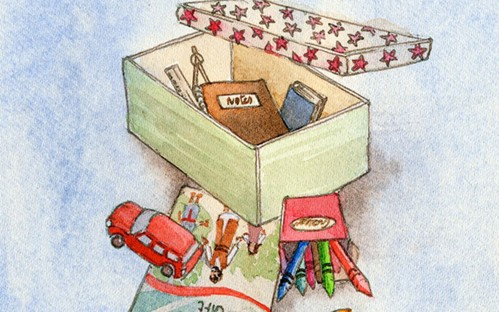 But after she received her shoebox, she says that she was the “coolest kid in school” because school supplies were packed inside is, such as crayons and colored markers.
“Just very simple things that our kids here probably will not be excited to receive for Christmas can mean so much — sometimes even the difference between life or death, meaning (kids) would either go to school with the school supplies they have or join a gang where they would lose their life,” says McMillon.
She explains that it is like that in many counties, so volunteers should never underestimate the power packed in their boxes.
For Nicholson, her biggest impact was “The Greatest Gift” storybook that came with the box. The booklet is used to evangelize and disciple children.
She said it was the first time she heard of Jesus.
“When I read it, I thought it was the biggest fairy tale I had ever read. Because I had nothing to hold on to or nothing to hope for as an orphan girl. By the age of 18, I would have been kicked out. There was no hope for me to survive after that,” explains Nicholson.
She states, however, that the booklet became her hope.
“I started to pray and I was like hoping that there was someone out there who was bigger than I am, who was in control. And I prayed for a family that would want me and my sisters together because we were kind of a package deal. And in 2004, he provided that family,” says Nicholson.
Photos and illustrations: Operation Christmas Child