

The state of Texas wants public schools to display posters of the Ten Commandments in classrooms.
The New Orleans-based Fifth Circuit Court of Appeals gave its blessing Tuesday, and attorney Garrett Bell of First Liberty Institute said it's a great ruling for Texas.
"It acknowledged that the Ten Commandments are part of the nation's history and tradition and that banning them from schools because they are religious is not justified by the Constitution," Bell told AFN.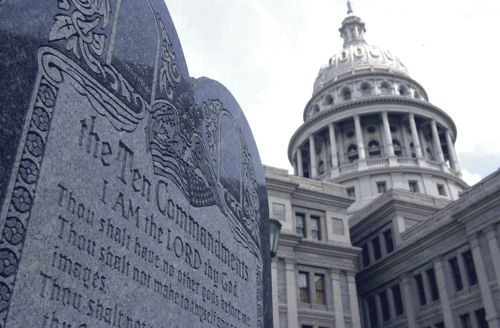
The law is not intended to proselytize students, rather pay tribute to the impact that the Ten Commandments had on the nation's legal system, Texas officials say.
Tuesday's ruling comes after the appeals court heard arguments in January in the Texas case and a similar case in Louisiana. In February, the court cleared the way for Louisiana to enforce its law requiring the display of the Ten Commandments in classrooms. That was after the court said the groups challenging Louisiana's law had no standing.
The Texas ruling was different.
"In this Texas case, they decided it on the merits," said Bell. "They went through the full analysis of the First Amendment's Establishment Clause as well as the First Amendment Free Exercise Clause."
The American Civil Liberties Union (ACLU) issued a statement Tuesday saying that multifaith families "condemn" the Texas ruling.
The ACLU was involved in the case, along with Americans United for Separation of Church and State and the Freedom From Religion Foundation.

"The Court's ruling goes against fundamental First Amendment principles and binding U.S. Supreme Court authority," the ACLU said in a press release. "The First Amendment safeguards the separation of church and state, and the freedom of families to choose how, when and if to provide their children with religious instruction."
According to ACLU, this decision "tramples" those rights.
"We anticipate asking the Supreme Court to reverse this decision and uphold the religious-freedom rights of children and parents," an ACLU statement said.
The ruling is limited to the Fifth Circuit, meaning that this opinion would not be binding authority on any other circuit or any other state within a different circuit.
Louisiana, Mississippi, and Texas are the only states in the Fifth Circuit.
Still, Bell said the ruling is persuasive and could help Arkansas in a legal battle over that state's Ten Commandments law.
"The lower court ruled against the Ten Commandments, but that is likely going to be appealed to the Eighth Circuit, and so the Eighth Circuit will likely look to this opinion in the Fifth to possibly garner some of its reasoning and use some of its reasoning."