
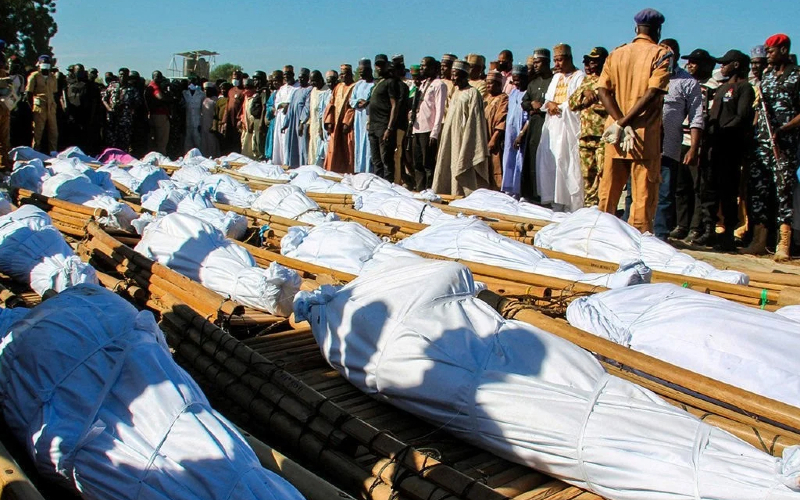
Associated Press and others have reported that the city of Jos in the Plateau state, located in the north-central region of Nigeria, was attacked by gunmen last week. The attack happened in the Gari Ya Waye community in the Angwan Rukuba residential neighborhood.
According to All Africa, the governor of the Plateau state, Caleb Mutfwang, confirmed that 28 people were killed as a result. A 48-hour curfew was imposed in the aftermath of the devastation to deter any further attacks and restore normalcy as security agencies work.
AFN has previously reported on U.S. action in Nigeria, including the Christmas strikes and the recent deployment of troops.
No one has claimed responsibility for the Plateau attack, but Mutfwang revealed there is a suspect in custody.
Arielle Del Turco is the director of the Center for Religious Liberty for Family Research Council. She spoke with Jody Hice on “Washington Watch” this week about how the recent attack was close to where she recently visited.
Del Turco notes how the northern part of Nigeria is where many of these conflicts between Christian and Muslim villages take place. The Fulani are a Muslim-majority tribe in Nigeria and other parts of Africa, and as she explains, these attacks are normally carried out by Fulani militants.
“They will storm into a village, typically in the middle of the night, often on motorcycles, extremely fast and hard to track from the military, and just slaughter villages. They’ll take people for ransom, kidnap them. They’ll commit all sorts of horrific crimes,” Del Turco says.
The latest incident is just another of many Fulani attacks seen in Nigeria for many years.

During a recent trip to Nigeria, Del Turco spoke to many victims who have endured these attacks and the aftermath of them. One particular woman described what happened during these attacks.
“Her village was unfortunately targeted routinely by attacks. She said what she did is that she would just stay in her house with her doors locked and pray, even though she knows that these door locks can't stop the Fulani militants if they choose to target her house,” Del Turco says. “So that's the reality that so many of these people are living in, and they don't really have the means to move, and their entire families are in these villages.”
She comments how shocked she was to hear how matter-of-factly some of the people would talk about the attacks. Because they have been going on for so long, residents have become immune to the shock of the attacks. Such violence has become a part of their normal lives now, Del Turco notes sadly.
Thankfully, Del Turco says international awareness is increasing, especially with President Donald Trump bringing attention to it last November. It was widely reported at the time that Trump designated Nigeria as a Country of Particular Concern (CPP).
“I think that really woke up the Nigerian government to be like, hey, this isn't just a domestic issue that's always going to happen, and we don't really want to address. It's actually something that the U.S. government wants us to address, which was a very powerful move,” Del Turco states.
In fact, Del Turco believes there is a lot that Western governments can be doing to help the Nigerian government.
“We really need to see more concentration from Western governments who are able to help advise the Nigerian government on security matters, on justice matters. We see routinely that these attackers don't face any sort of punishment by the justice system,” she says.
Del Turco claims the designation was encouraging after President Joe Biden refused to apply it during his term despite ample evidence of persecution.
She explains the Trump administration is now developing their game plan for how exactly they're going to address this problem.
“This has been brought to the top of the State Department's priority list, and President Trump is reviewing the recommendations that he asked Rep. Riley Moore to compile. Now we really just need to see what actions President Trump is going to take, and maybe some of those will be private with the Nigerian government,” Del Turco says.