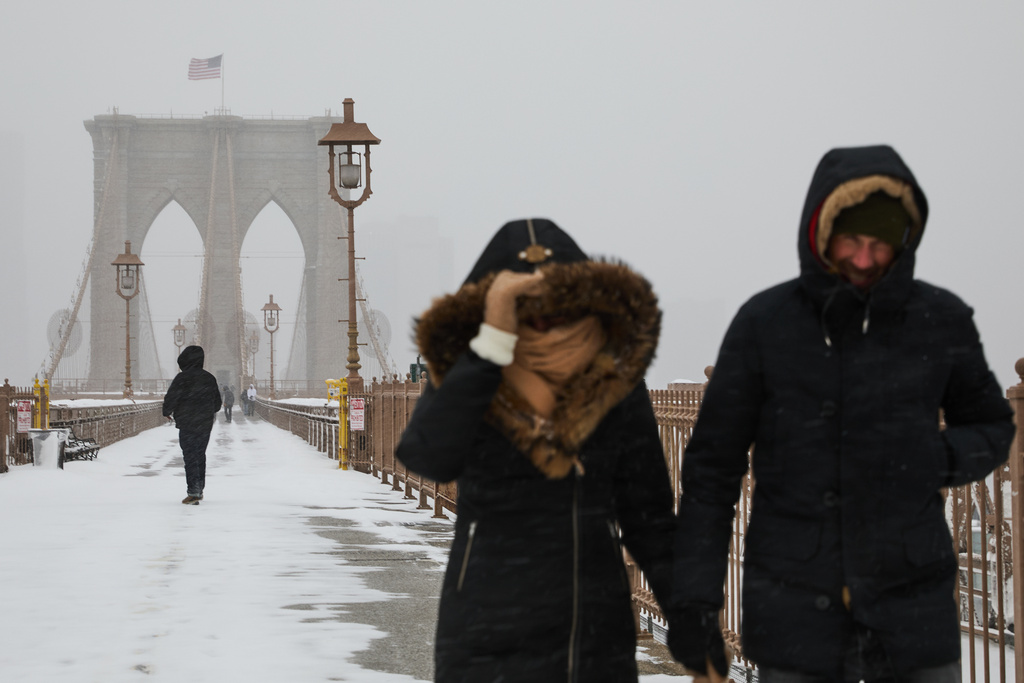


Deep snow — over a foot extending in a 1,300-mile swath from Arkansas to New England — halted traffic, canceled flights and triggered wide school closures Monday. The National Weather Service said areas north of Pittsburgh got up to 20 inches of snow and faced wind chills as low as minus 25 degrees Fahrenheit late Monday into Tuesday.
A rising death toll included two people run over by snowplows in Massachusetts and Ohio, fatal sledding accidents in Arkansas and Texas, and a woman whose body was found covered in snow by police with bloodhounds after she was last seen leaving a Kansas bar. In New York City, officials said eight people were found dead outdoors in the course of the frigid weekend.
There were more than 750,000 power outages in the nation by Monday midafternoon, according to poweroutage.com. Most of them were in the South, where weekend blasts of freezing rain caused tree limbs and power lines to snap, inflicting crippling outages on northern Mississippi and parts of Tennessee.
Parts of Mississippi were reeling in the aftermath of the state's worst ice storm since 1994. Officials scrambled Monday to get cots, blankets, bottled water and generators to warming stations in hard-hit areas.
The University of Mississippi, where most students hunkered down without power Monday, canceled classes for the entire week as its Oxford campus remained coated in treacherous ice. Oxford Mayor Robyn Tannehill said on social media that so many trees, limbs and power lines had fallen that “it looks like a tornado went down every street.”
A pair of burly, falling tree branches damaged real estate agent Tim Phillips' new garage, broke a window and cut off power to his home in Oxford. He said half of his neighbors had homes or vehicles damaged.
“It’s just one of those things that you try to prepare for,” Phillips said, “but this one was just unreal.”
The U.S. had more than 8,000 flight delays and cancellations nationwide Monday, according to flight tracker flightaware.com. On Sunday, 45% of U.S. flights got cancelled, making it the highest day for cancellations since the COVID-19 pandemic, according to aviation analytics firm Cirium.
More light to moderate snow was forecast in New England through Monday evening.
New York City saw its snowiest day in years, with 11 inches falling on Central Park. Main roads throughout the city were largely clear Monday morning, but pedestrians had to plod through snow on some sidewalks and multiple subway lines with above-ground tracks saw delays.
Meanwhile, bitter cold followed in the storm's wake. It got down to minus 40 degrees Fahrenheit (minus 40 Celsius) in parts of Minnesota on Sunday. Many communities across the Midwest, South, and Northeast awakened Monday to subzero weather. The entire Lower 48 states were forecast to have their coldest average low temperature of minus 9.8 F — since January 2014.
Record warmth in Florida was the only thing keeping that average from going even colder, said former National Oceanic and Atmospheric Administration chief scientist Ryan Maue, who calculates national averages based on National Weather Service data.
From Montana to the Florida Panhandle, the weather service posted cold weather advisories and extreme cold warnings as temperatures in many places dipped to zero (minus-18 degrees Celsius) and even colder. Wind made conditions even chillier and the overnight cold refreezed roads early Monday in a cruel reprise of the weekend's lousy travel weather.
Even with precipitation ending in Mississippi, “that doesn't mean the danger is behind us," Gov. Tate Reeves said in a news conference Sunday.
Freezing rain that slickened roads and brought trees and branches down on roads and power lines were the main peril in the South over the weekend. In Corinth, Mississippi, heavy machinery manufacturer Caterpillar told employees at its remanufacturing site to stay home Monday and Tuesday.
It already was Mississippi’s worst ice storm since 1994 with its biggest-ever deployment of ice-melting chemicals — 200,000 gallons — plus salt and sand to treat icy roads, Reeves said. He urged people not to drive anywhere unless absolutely necessary. “Do please reach out to friends and family,” Reeves added.
At one point Sunday morning, about 213 million people were under some sort of winter weather warning, authorities said.
Some 12,000 flights also were canceled Sunday and nearly 20,000 were delayed.
Storm leads to deaths in a number of states
In New York City, Mayor Zohran Mamdani said at least eight people who died were found outside as temperatures plunged Saturday, though the cause of their deaths remained under investigation. Two men died of hypothermia related to the storm in Caddo Parish in Louisiana, according to the state health department.
In Emporia, Kansas, police searching with bloodhounds found a 28-year-old teacher dead and covered in snow. Police said she had was last seen leaving a bar without her coat and phone.
Police said snowplows backed into two people who died in Norwood, Massachusetts, and Dayton, Ohio. And authorities said two teenagers, one in Arkansas and another in Texas, were killed in sledding accidents.
Officials reported three deaths apiece in Louisiana, Pennsylvania and Tennessee; two deaths in Mississippi; and one in New Jersey.